
The molecule, in three dimensions
- Heavy atoms
- 23
- Bonds
- 22
- Composition
- C12 N3 O8
- Rings
- None
- Metal centre
- None
- Chain length
- 3 residues
Every heavy atom is placed from the sequence with ideal bond lengths and angles, so the connectivity is exact. The pose is idealised, an extended chain, and is not a measured conformation. Identity for the lot in stock is confirmed by LC-MS on its certificate.
Molecular data
| Molecular formula | C12H19N3O8 |
|---|---|
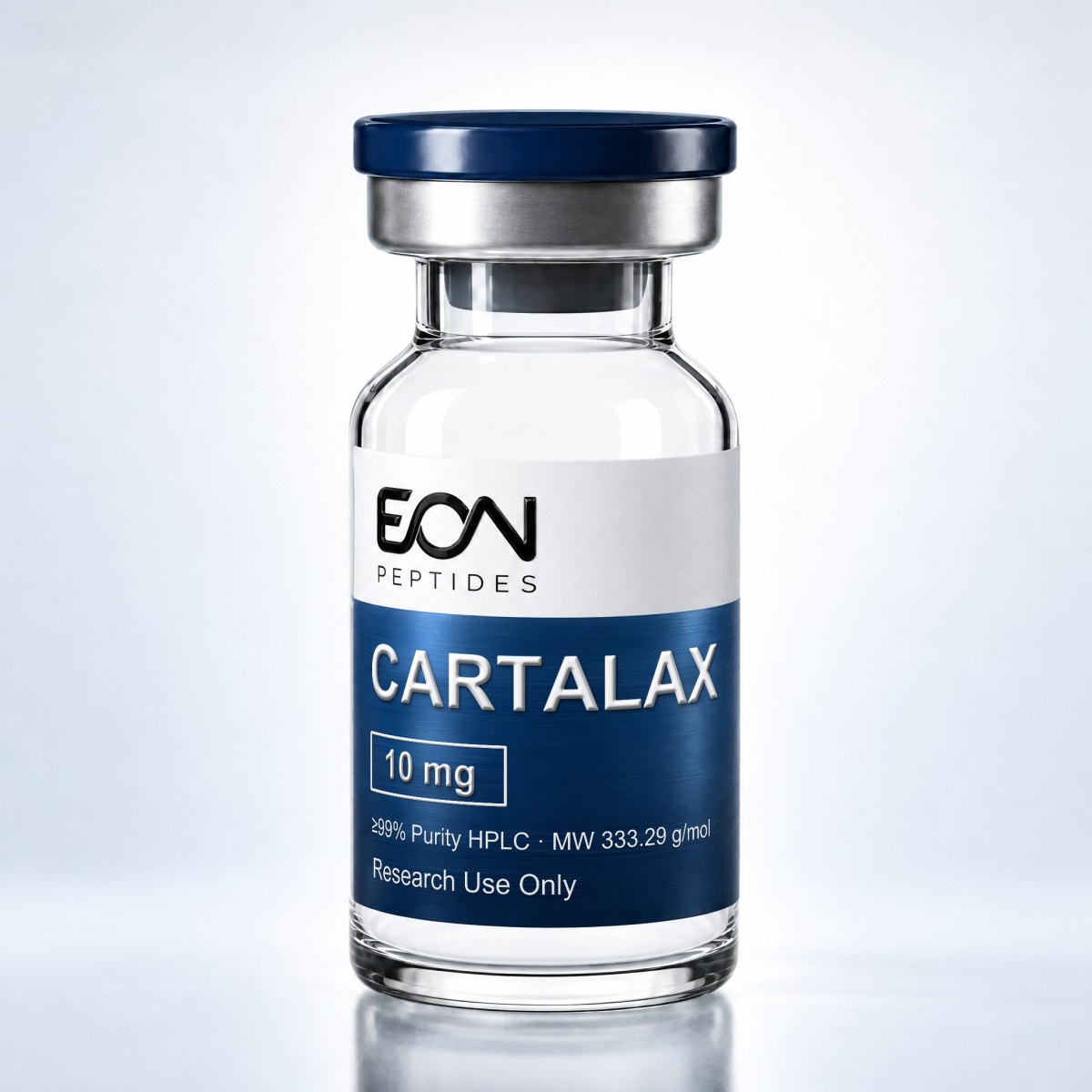
| Molecular weight | 333.29 Da |
| Sequence | Ala-Glu-Asp |
| Sequence length | 3 residues |
| Physical form | Lyophilized powder |
| Available sizes | 10mg |
The sequence
Cartalax is published as a 3-residue sequence. It is set below in reading order, ten residues to a row, numbered from the N-terminus. Every position is a standard L-amino acid.
- A Ala
- E Glu
- D Asp
One-letterAED
- Residues
- 3
- Published as
- Three-letter code
- Termini
- Not stated in the specification
How it works
-
Peptide-DNA Interaction
Gene-Level Bioregulation
Cartalax is a short tripeptide (Ala-Glu-Asp). Research from the Khavinson group proposes that peptides of this class interact with chromatin and the promoter regions of specific genes, influencing transcription of tissue-specific proteins.
- Proposed binding to promoter regions of specific genes
- Associated with sequence-specific changes in gene expression
- Studied as an epigenetic-level regulator rather than a receptor agonist
-
Connective Tissue
Cartilage & Chondrocyte Focus
AED is studied as a bioregulator for cartilage and connective tissue. Cell-culture research has examined its effect on chondrocytes and fibroblasts, with proliferation and extracellular-matrix markers as measured endpoints.
- Studied in chondrocyte and fibroblast cultures
- Extracellular-matrix markers measured
- Proliferation endpoints measured
-
Cellular Aging
Aging Cell-Culture Models
Short-peptide bioregulators are investigated in models of cellular aging. For AED, studies have examined markers of proliferation and apoptosis in aging connective-tissue cell cultures.
- Studied in aging cell-culture models
- Apoptosis markers measured
- Investigated alongside other short-peptide bioregulators
What the research shows
-
CONNECTIVE TISSUE
Cartilage & Chondrocyte Models
AED is studied as a cartilage-associated bioregulator, with chondrocyte proliferation and matrix markers as measured endpoints in cell-culture research.
-
MOLECULAR BIOLOGY
Peptide-Gene Expression
Short peptides of this class are studied as regulators of gene expression and protein synthesis, with proposed binding to specific DNA promoter regions.
-
GERONTOLOGY
Cellular Aging Models
AED is investigated in aging cell-culture models, measuring proliferation and apoptosis markers in connective-tissue cells.
-
MUSCULOSKELETAL
Musculoskeletal Tissue Research
Cartalax is studied alongside other short-peptide bioregulators in research on joint and connective-tissue biology.
Specification
| Chemical Name | Cartalax (Ala-Glu-Asp) |
|---|---|
| Sequence | L-Alanyl-L-Glutamyl-L-Aspartic acid (AED tripeptide) |
| Molecular Weight | 333.29 g/mol |
| Molecular Formula | C₁₂H₁₉N₃O₈ |
| Form | Lyophilized powder |
| Purity | ≥99% (HPLC verified) |
| Testing | Third-party HPLC, Mass Spec, Endotoxin |
| Storage | -20°C for long-term stability |
| Solubility | Water-soluble |
| COA | Included with every order |
How it's tested
Every lot of Cartalax released to the catalog carries a third-party certificate of analysis. 1 documented lot is on file for this compound, with reported HPLC purity from 99.99% to 99.99% (mean 99.99%), issued by Freedom Diagnostics. 1 of 1 certificates record identity as confirmed.
- Documented lots
- 1
- Reported purity
- 99.99% to 99.99%
- Mean purity
- 99.99%
- Issuing labs
- Freedom Diagnostics
- 2026-10-03 Lot R8S654Freedom Diagnostics 99.99% View certificate
Frequently asked questions
What is Cartalax?
Cartalax is a synthetic tripeptide, Ala-Glu-Asp (AED), from the short-peptide bioregulator research of the Khavinson group. It is studied in cartilage and connective-tissue models.
How does it relate to Pinealon and Epithalon?
All three are short-peptide bioregulators from the same line of research. Pinealon (EDR) is studied in neuronal models, Epithalon (AEDG) in pineal and telomere research, and Cartalax (AED) in cartilage and connective-tissue models.
What is the molecular weight and purity?
Cartalax has a molecular weight of 333.29 g/mol. Every vial is supplied at ≥99% purity, verified by HPLC, with a Certificate of Analysis included.
How should it be stored?
Store lyophilized vials at -20°C for long-term stability, protected from light and moisture.
Is this product for human use?
No. Cartalax is sold strictly as a research compound for laboratory and in-vitro use only. It is not intended for human or animal consumption, diagnosis, or treatment.
Cross-references
Other entries in this volume that bear on Cartalax, with the reason each one is listed.
- SS-31 longevity and cellular research Mitochondrial Function Studies
- ARA-290 longevity and cellular research EPO-derived 11-mer · innate repair receptor agonist
- Epithalon longevity and cellular research Telomere Lengthening Studies
- Thymosin Alpha-1 longevity and cellular research Immune Response Studies
For laboratory research use only. Not a drug, supplement, or medical product; not for human or animal use. All findings referenced are from published preclinical/laboratory research.