Tendon & Ligament
Achilles tendon, MCL and rotator cuff models in rats, with collagen fibre organisation among the measured endpoints.

Pentadecapeptide · Preclinical Models
Free Shipping on orders over $200
Scan the QR code on any vial to verify its batch, COA, and origin in seconds. Secure traceability from our lab to your bench.
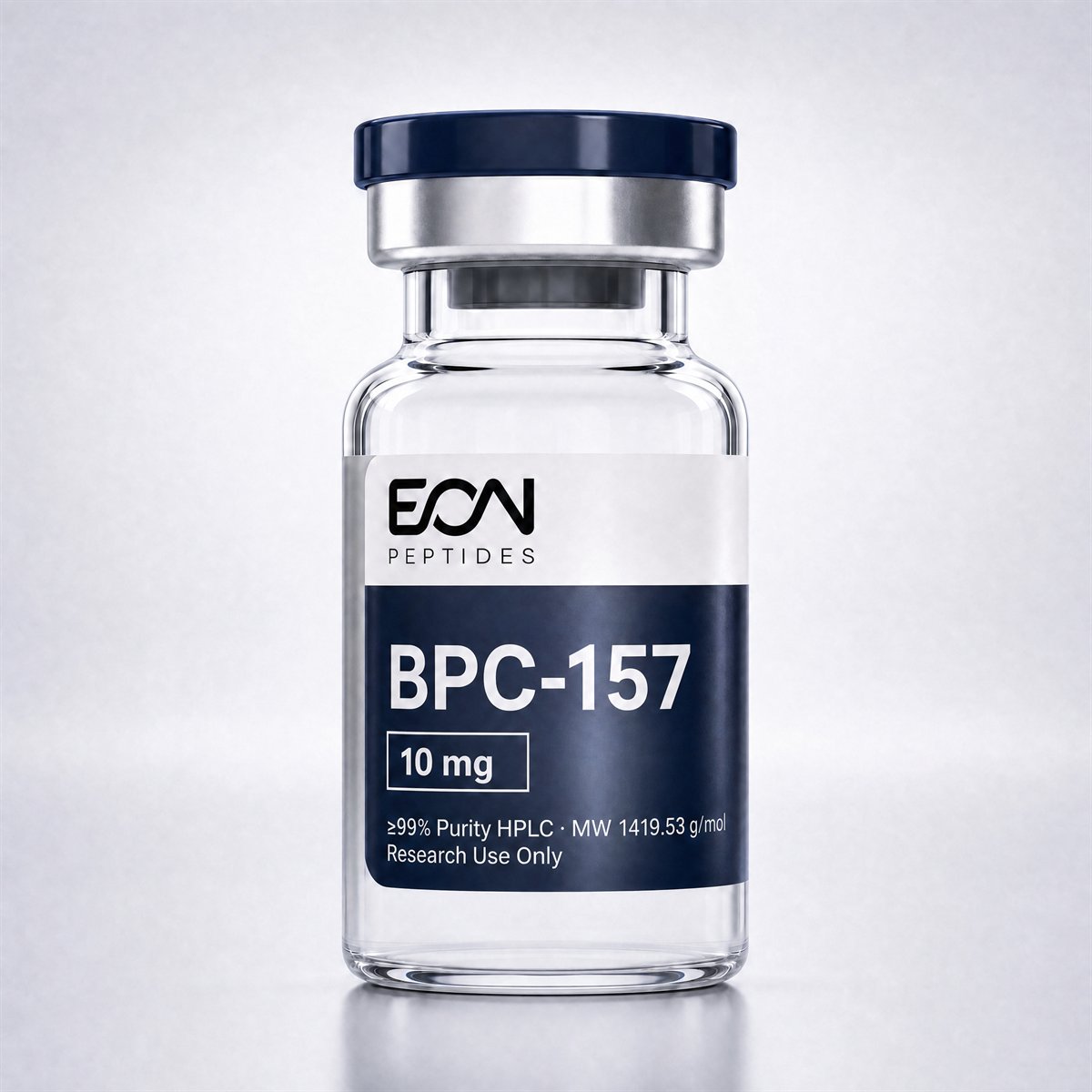
BPC-157 is a synthetic peptide, 15 amino acids long. It copies part of a larger protein found in human stomach fluid. Research in animal models has measured new blood vessel growth, how tendon cells move and spread, and how tissue remodels after injury. It holds up in stomach acid better than most peptides, which is unusual and has been studied on its own.
Synthetic pentadecapeptide (15 amino acids)
The pathways BPC-157 acts on — and what each one does. The animation traces its signal outward from the compound to every target it engages.
In preclinical models, raised vascular endothelial growth factor (VEGF) expression has been measured following BPC-157 exposure, with vessel formation and perfusion recorded in the same models.
Growth hormone receptor expression in cultured tendon fibroblasts has been measured at approximately 7× baseline within 3 days of exposure.
Cytoprotective endpoints have been examined across several organ systems in animal studies, most often in gastrointestinal and musculoskeletal tissue.
The main areas BPC-157 is being studied for — and the study-reported figures behind them.
Achilles tendon, MCL and rotator cuff models in rats, with collagen fibre organisation among the measured endpoints.
Cytoprotective endpoints examined in NSAID-induced injury, alcohol lesion and colitis models.
Neuroprotective endpoints examined in traumatic brain injury and peripheral nerve models, including functional markers.
Studied for angiogenesis after surgical transection in animal models, via NO system modulation.
An interactive 3D model rendered from the compound record — rotate and explore its structure.
C62H98N16O22
| Sequence | Gly-Glu-Pro-Pro-Pro-Gly-Lys-Pro-Ala-Asp-Asp-Ala-Gly-Leu-Val |
| Molecular Weight | 1419.53 Da |
| Molecular Formula | C₆₂H₉₈N₁₆O₂₂ |
| Form | Lyophilized powder (5mg) |
| Purity | ≥99% (HPLC verified) |
| Testing | Third-party HPLC, Mass Spec, Endotoxin |
| Storage | -20°C for long-term stability |
| Solubility | Water-soluble |
| COA | Included with every order |
BPC-157 (Body Protection Compound-157) is a synthetic 15-amino acid peptide derived from a larger protein found in human gastric juice. It was first characterised at the University of Zagreb, Croatia, and has been studied extensively in animal models across cytoprotective and tissue-remodelling endpoints.
No. BPC-157 is not approved by the FDA or any regulatory agency for human use. It is classified as an unapproved drug. The FDA has issued warnings about BPC-157 being found in compounded products and dietary supplements. Only one Phase I clinical trial has been registered, and no Phase 2 or 3 trials have been completed.
Preclinical research (animal studies) has reported BPC-157 in tendon, ligament, muscle and bone models; in gastrointestinal lesion and inflammation models; in neuroprotection models of brain injury; and in blood-vessel formation. All findings are from animal studies - no human clinical data exists.
BPC-157 has been studied in rodent models and in cultured cell systems, with tissue-remodelling and gastrointestinal endpoints. Study design, concentrations and endpoints differ between experiments.
No lethal dose was reached in preclinical toxicology studies, and no significant adverse effects have been reported in published research. However, BPC-157 has never completed human clinical trials, so its safety profile in humans is unknown. It should only be used for in vitro laboratory research.
Lyophilized (powder) form should be stored at -20°C for long-term stability, protected from light and moisture. BPC-157 is notably stable — it resists hydrolysis, enzymatic degradation, and gastric acid.
Not for human or veterinary use. For in-vitro laboratory research only. These statements have not been evaluated by the FDA; this product is not intended to diagnose, treat, cure, or prevent any disease. Sold exclusively to qualified researchers and institutions.