Growth Hormone Axis
Used as a research probe of pituitary GH secretory reserve; the GHRH stimulation test has historically been employed to assess somatotroph function.

GH Secretion Studies
Free Shipping on orders over $200
Scan the QR code on any vial to verify its batch, COA, and origin in seconds. Secure traceability from our lab to your bench.
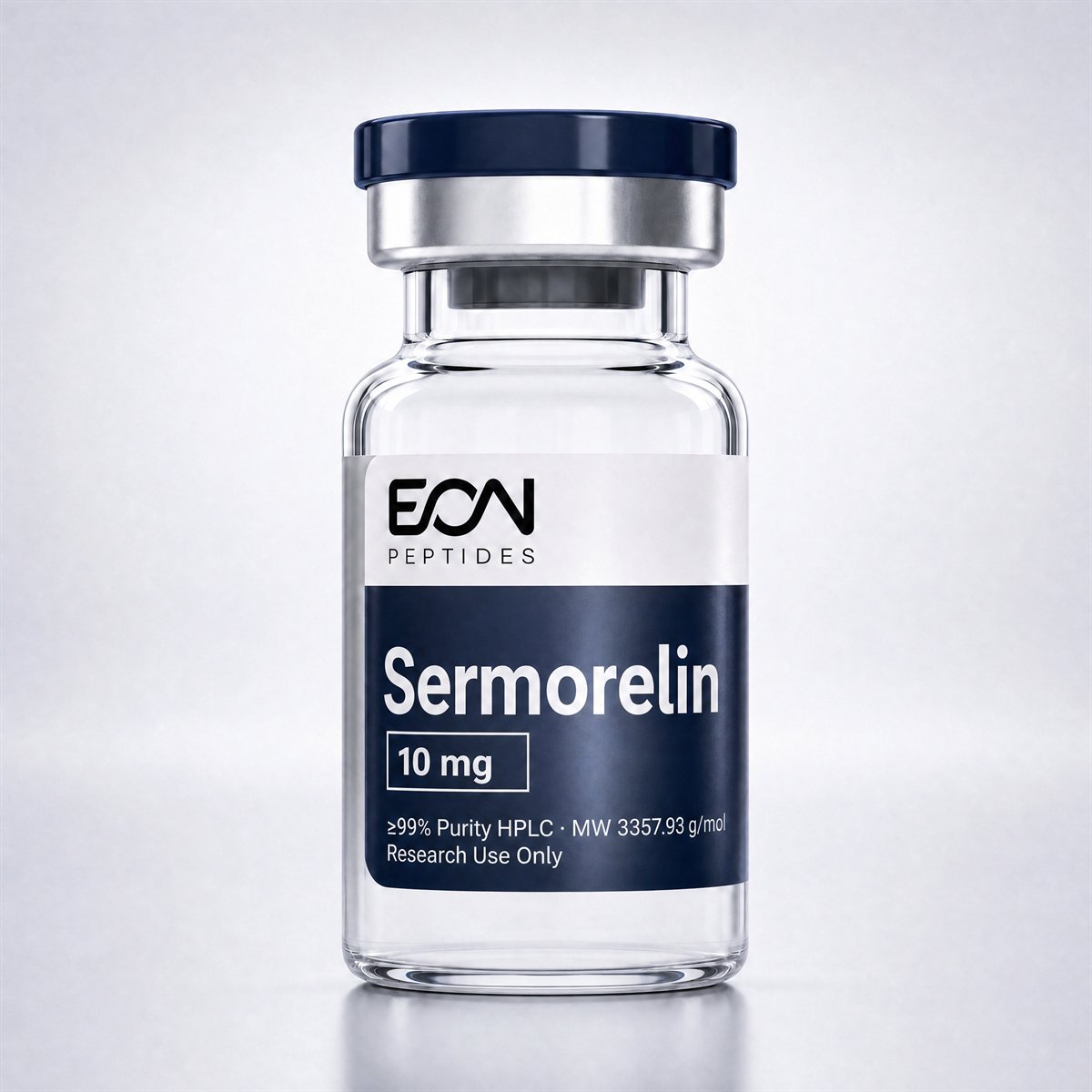
Sermorelin is a 29 amino acid fragment of GHRH, the hormone that signals growth hormone release. It is the shortest piece of that hormone that still works. Studies have measured the response in pituitary cells and the growth hormone release that follows. Because it clears quickly, researchers use it when the timing of a signal matters more than its duration.
Growth hormone-releasing hormone (GHRH) analog; N-terminal 29-amino-acid fragment of human GHRH
The pathways Sermorelin acts on — and what each one does. The animation traces its signal outward from the compound to every target it engages.
Sermorelin binds growth hormone-releasing hormone receptors on anterior-pituitary somatotrophs, stimulating the synthesis and pulsatile release of endogenous growth hormone rather than supplying it exogenously.
Raised growth hormone is followed by hepatic production of insulin-like growth factor 1 (IGF-1), the principal mediator of GH signalling in muscle, bone, connective tissue and lipid metabolism.
Because the action is upstream at the pituitary, GH output remains subject to somatostatin and IGF-1 negative feedback, preserving the endogenous secretory rhythm rather than a fixed exogenous level.
Unlike recombinant HGH, which supplies growth hormone directly, Sermorelin acts on the pituitary to release endogenous GH — preserving the hypothalamic–pituitary axis and its regulatory checkpoints.
The main areas Sermorelin is being studied for — and the study-reported figures behind them.
Used as a research probe of pituitary GH secretory reserve; the GHRH stimulation test has historically been employed to assess somatotroph function.
GH secretagogues are studied for their influence on lean body mass, fat mass, and metabolic rate in models of age- or disease-related GH decline.
Endogenous GH release is tightly coupled to slow-wave sleep, so GHRH analogs are studied to explore the link between the somatotropic axis and sleep architecture.
Age-related decline in GH and IGF-1 — termed somatopause — is modelled with GHRH analogs to study changes in secretory patterns.
An interactive 3D model rendered from the compound record — rotate and explore its structure.
C149H246N44O42S
How Sermorelin clears from circulation, modeled from its documented ~~10–20 minutes (plasma) half-life. The curve draws as you scroll.
| Compound Class | Growth hormone-releasing hormone (GHRH) analog |
| Research Name | Sermorelin (GHRH 1–29) |
| Sequence | N-terminal 29-amino-acid fragment of human GHRH |
| Target | GHRH receptor (pituitary somatotrophs) |
| Form | Lyophilized powder |
| Molecular Weight | 3,357.93 g/mol |
| Purity | ≥99% (HPLC verified) |
| Testing | Third-party HPLC, Mass Spec, Endotoxin |
| Half-Life | ~10–20 minutes (plasma) |
| Storage | -20°C for long-term stability |
| Solubility | Water-soluble |
| COA | Included with every order |
| Appearance | White to off-white powder |
| Quantity | 5mg |
| Stability | 24 months from manufacture date when stored properly |
Sermorelin is a synthetic analog of the first 29 amino acids of growth hormone-releasing hormone (GHRH) - the shortest fully active fragment. It is studied for pituitary stimulation of endogenous growth hormone secretion in a pulsatile pattern.
Recombinant HGH supplies growth hormone directly, whereas Sermorelin stimulates endogenous GH release by acting upstream at the pituitary. This preserves the hypothalamic–pituitary feedback loop and a more physiologic secretory rhythm.
Sermorelin has a molecular weight of 3,357.93 g/mol. Every vial is supplied at ≥99% purity, verified by HPLC, with a Certificate of Analysis included.
Keep lyophilized vials at -20°C for long-term stability, protected from light and moisture.
No. Sermorelin is sold strictly as a research compound for laboratory and in-vitro use only. It is not intended for human or animal consumption, diagnosis, or treatment.
Not for human or veterinary use. For in-vitro laboratory research only. These statements have not been evaluated by the FDA; this product is not intended to diagnose, treat, cure, or prevent any disease. Sold exclusively to qualified researchers and institutions.