Aging & Senescence
Extended lifespan has been recorded in several model organisms following NAD+ exposure, alongside sirtuin pathway activity and mitochondrial function measures.

Cellular Energy Studies
Free Shipping on orders over $200
Scan the QR code on any vial to verify its batch, COA, and origin in seconds. Secure traceability from our lab to your bench.
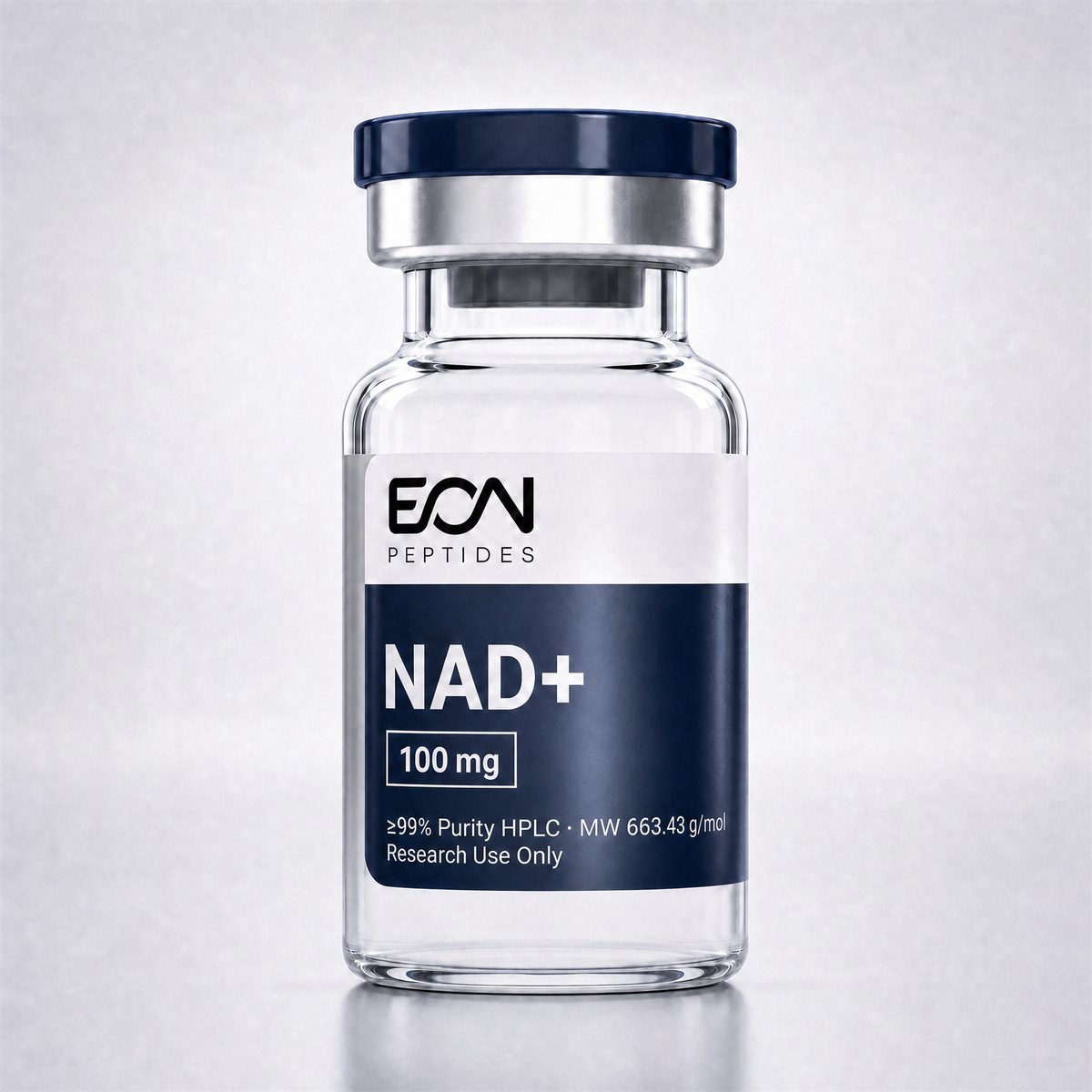
NAD+ is a coenzyme, a helper molecule that cells need to produce energy. Every living cell contains it. It works by carrying electrons from one reaction to the next. Studies have measured its role in mitochondria, in cell signaling, and in DNA repair. Levels inside cells decline with age across many tissue types.
Pyridine dinucleotide coenzyme
The pathways NAD+ acts on — and what each one does. The animation traces its signal outward from the compound to every target it engages.
NAD+ is essential for mitochondrial electron transport chain function, directly participating in the conversion of nutrients to cellular energy (ATP). Declining NAD+ levels impair mitochondrial efficiency.
NAD+ is the obligate co-substrate for all 7 sirtuin enzymes (SIRT1-7), which regulate aging, inflammation, stress resistance, and metabolic homeostasis. Without NAD+, sirtuins cannot function.
PARP enzymes consume NAD+ to repair DNA damage. Falling NAD+ with age is associated with lower DNA repair capacity, cellular senescence and genomic instability.
The main areas NAD+ is being studied for — and the study-reported figures behind them.
Extended lifespan has been recorded in several model organisms following NAD+ exposure, alongside sirtuin pathway activity and mitochondrial function measures.
Declining NAD+ is associated with a pseudohypoxic state and disrupted nuclear-mitochondrial communication. In animal models, raised NAD+ levels have been recorded alongside changes in age-related metabolic markers.
NAD+ fuels PARP enzymes responsible for single-strand DNA break repair. Depletion leads to accumulated DNA damage and accelerated cellular aging.
The NAD+/sirtuin pathway engages the mitochondrial unfolded protein response (UPRmt), a stress-response mechanism studied in ageing research.
An interactive 3D model rendered from the compound record — rotate and explore its structure.
C₂₁H₂₇N₇O₁₄P₂
| Full Name | Nicotinamide Adenine Dinucleotide |
| Molecular Weight | 663.43 Da |
| Molecular Formula | C₂₁H₂₇N₇O₁₄P₂ |
| Form | Lyophilized powder |
| Purity | ≥99% (HPLC verified) |
| Testing | Third-party HPLC, Mass Spec, Endotoxin |
| Storage | -20°C for long-term stability |
| Solubility | Water-soluble |
| COA | Included with every order |
NAD+ (Nicotinamide Adenine Dinucleotide) is an essential coenzyme found in every living cell. It participates in over 500 enzymatic reactions and is critical for energy metabolism, DNA repair, and cellular signaling. NAD+ levels naturally decline with age, which researchers believe contributes to age-related metabolic dysfunction.
NAD+ levels decline approximately 50% by age 50, and that decline tracks with mitochondrial function, sirtuin enzyme activity and DNA repair capacity. In animal models, raised NAD+ levels have been recorded alongside changes in some age-related markers.
Sirtuins (SIRT1-7) are a family of enzymes studied in ageing, metabolism, inflammation and stress resistance. They are completely dependent on NAD+ as a co-substrate — without sufficient NAD+, sirtuins cannot function.
NAD+ is the active coenzyme itself. NMN (Nicotinamide Mononucleotide) and NR (Nicotinamide Riboside) are precursors that cells convert into NAD+. Applying NAD+ directly bypasses the conversion steps, while NMN and NR rely on cellular enzymes to produce NAD+.
Lyophilized NAD+ should be stored at -20°C for long-term stability. NAD+ is sensitive to heat and light — always protect the material from direct light.
Not for human or veterinary use. For in-vitro laboratory research only. These statements have not been evaluated by the FDA; this product is not intended to diagnose, treat, cure, or prevent any disease. Sold exclusively to qualified researchers and institutions.