Memory & Learning
Cognitive function, memory consolidation and attention measures are recorded in animal models. The Russian pharmaceutical formulation has been approved there as a nootropic since 2011.

Cognitive Function Studies
Free Shipping on orders over $200
Scan the QR code on any vial to verify its batch, COA, and origin in seconds. Secure traceability from our lab to your bench.
Semax is a seven amino acid peptide developed at a Russian research institute. Part of its sequence comes from ACTH, a hormone, and the rest is a short tail that keeps enzymes from breaking it down. Research in rodent models has measured BDNF, a protein involved in neuron growth, along with dopamine and serotonin activity. Despite the ACTH origin, it shows no stress hormone activity in testing.
Synthetic heptapeptide analog of ACTH(4-10)
The pathways Semax acts on — and what each one does. The animation traces its signal outward from the compound to every target it engages.
Brain-derived neurotrophic factor (BDNF) levels up to 1.4-fold baseline have been measured in specific brain regions, alongside neuronal survival and synaptic plasticity endpoints.
Research demonstrates Semax modulates serotonergic and dopaminergic systems, influencing mood regulation, attention, and cognitive processing in preclinical models.
In ischemic stroke models, infarct volume, inflammatory gene expression and neuronal survival under oxygen deprivation are the recorded endpoints.
The main areas Semax is being studied for — and the study-reported figures behind them.
Cognitive function, memory consolidation and attention measures are recorded in animal models. The Russian pharmaceutical formulation has been approved there as a nootropic since 2011.
Infarct volume and neuronal survival are measured in cerebral ischemia models. The Russian pharmaceutical formulation is used clinically there; that use does not extend to this research material.
Neurotrophin and receptor expression are measured, alongside neuronal plasticity endpoints.
Lower pro-inflammatory cytokines and altered oxidative stress-related gene expression are measured in hippocampal tissue.
An interactive 3D model rendered from the compound record — rotate and explore its structure.
C37H51N9O10S
| Strength | 10mg |
| Molecular Formula | C37H51N9O10S |
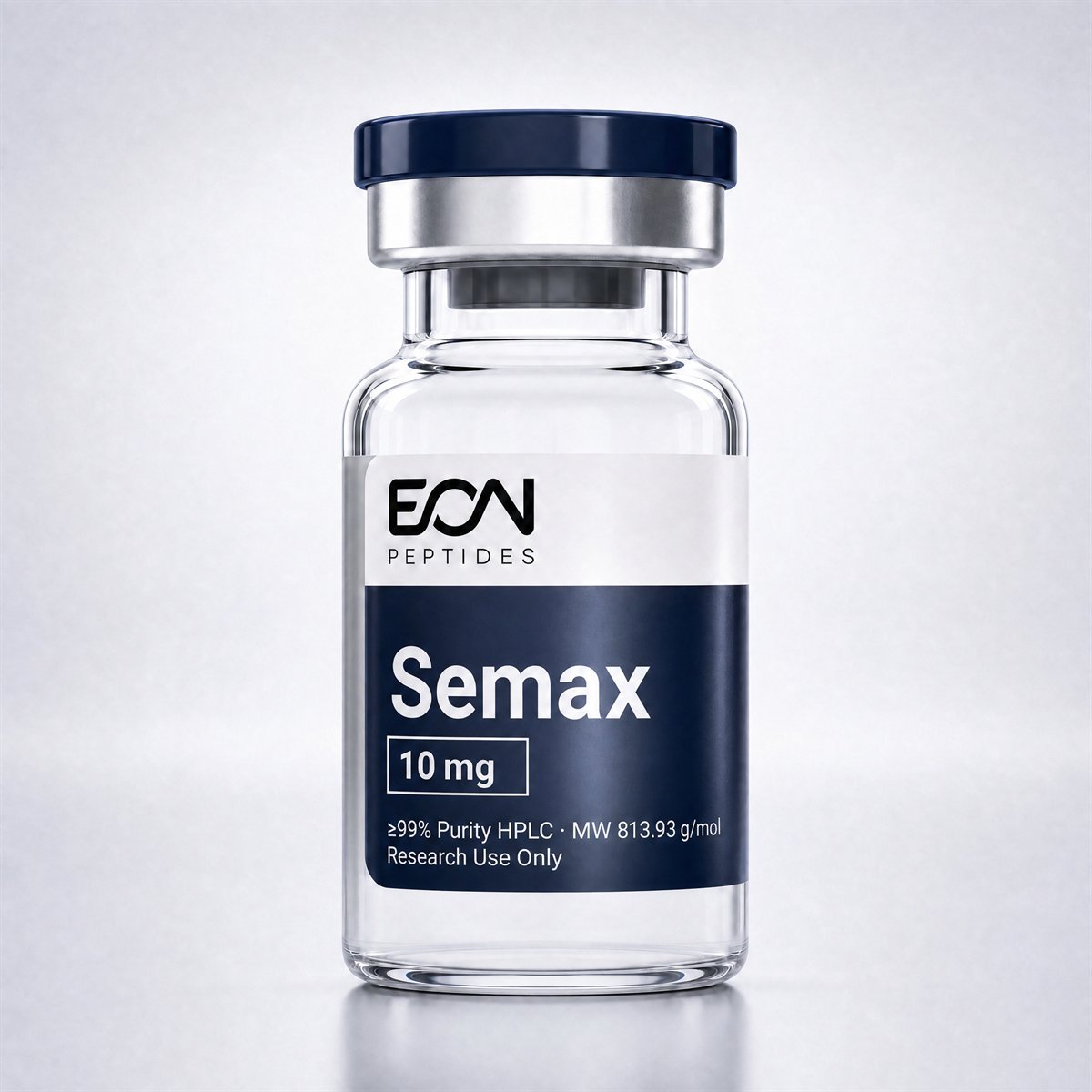
| Molecular Weight | 813.93 g/mol |
| Purity | >99% (HPLC) |
| Form | Lyophilized Powder |
| Sequence | Met-Glu-His-Phe-Pro-Gly-Pro |
| Origin | Synthetic analog of ACTH(4-10) |
| Testing | Third-party HPLC, Mass Spec, Endotoxin |
| Storage | -20°C for up to 24 months |
| Solubility | Water-soluble |
| COA | Included with every order |
| Appearance | White to off-white powder |
Semax (Met-Glu-His-Phe-Pro-Gly-Pro) is a synthetic heptapeptide derived from the first four amino acids of adrenocorticotropic hormone (ACTH 4-10). It was developed at the Institute of Molecular Genetics of the Russian Academy of Sciences in the 1980s and has been approved in Russia as a prescription nootropic since 2011.
Reported measures include BDNF levels up to 1.4-fold baseline, changes in serotonergic and dopaminergic systems, neuroprotective endpoints in ischemic stroke models, cognitive and memory measures in animal studies, and anti-inflammatory markers.
Semax is not approved by the FDA for any medical use in the United States. It is approved in Russia as a prescription medication for cognitive disorders and stroke recovery. In the US, it is available only as a research peptide for in vitro laboratory use.
N-Acetyl Semax (NASA) has an acetyl group added to the N-terminus, which raises stability and resistance to enzymatic degradation. Half-life is correspondingly longer than standard Semax.
Lyophilized Semax should be stored at -20°C for long-term stability (up to 24 months). Protect from heat and direct light.
Not for human or veterinary use. For in-vitro laboratory research only. These statements have not been evaluated by the FDA; this product is not intended to diagnose, treat, cure, or prevent any disease. Sold exclusively to qualified researchers and institutions.