Cellular Senescence
Studied in cell-culture and rodent models for markers of replicative senescence and cellular lifespan.

Telomere Lengthening Studies
Free Shipping on orders over $200
Scan the QR code on any vial to verify its batch, COA, and origin in seconds. Secure traceability from our lab to your bench.
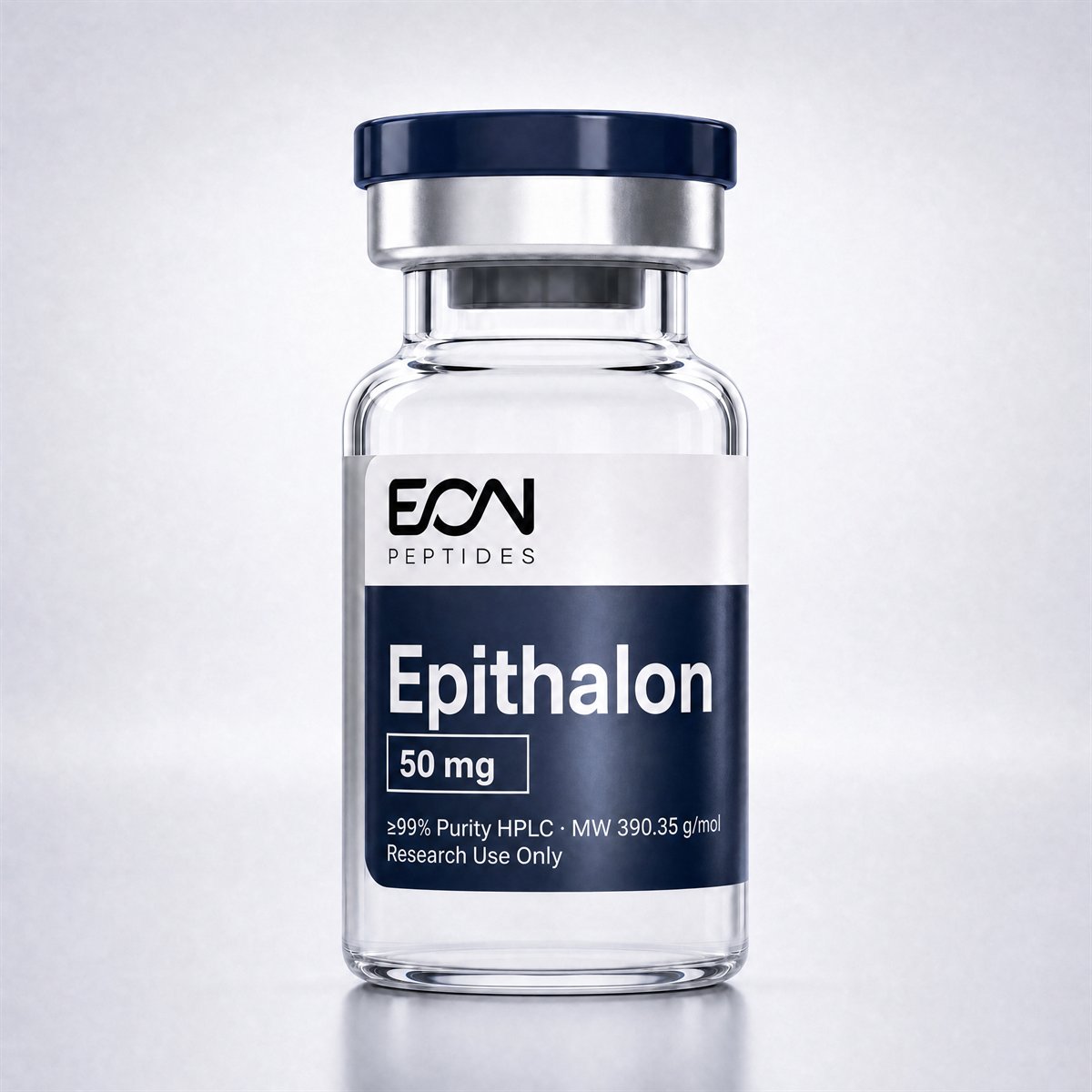
Epithalon is a peptide made of four amino acids. It comes from epithalamin, a pineal gland extract studied in the Soviet Union. Studies have measured telomerase activity and telomere length in cultured human cells. Sleep-wake timing has been examined in animal models. At four amino acids, it is one of the shortest active sequences in the research literature.
Synthetic tetrapeptide (Ala-Glu-Asp-Gly)
The pathways Epithalon acts on — and what each one does. The animation traces its signal outward from the compound to every target it engages.
In cultured human somatic cells, Epithalon has been reported to induce expression of the telomerase catalytic subunit (hTERT) and elongate telomeres, extending the proliferative capacity of the cultures in preclinical models.
Modeled on the pineal gland peptide epithalamin, Epithalon has been studied for its influence on melatonin secretion rhythm and circadian regulation in rodent models of aging.
Preclinical work reports that Epithalon can interact with DNA and modulate expression of genes associated with cellular senescence and antioxidant activity in animal tissue.
The main areas Epithalon is being studied for — and the study-reported figures behind them.
Studied in cell-culture and rodent models for markers of replicative senescence and cellular lifespan.
Investigated for effects on melatonin rhythm and age-related changes in pineal function in animal models.
Preclinical reports of lower lipid peroxidation and changes in antioxidant enzyme activity in aged animal tissue.
Used as a reference tetrapeptide in rodent studies of lifespan, tumour incidence, and physiological aging markers.
An interactive 3D model rendered from the compound record — rotate and explore its structure.
C14H22N4O9
| Strength | 50mg |
| Molecular Formula | C14H22N4O9 |
| Molecular Weight | 390.35 g/mol |
| Purity | >99% (HPLC) |
| Form | Lyophilized Powder |
| Appearance | White to off-white powder |
| Verified Purity | >99% |
| Quantity | 5mg |
Epithalon (also spelled Epitalon) is a synthetic tetrapeptide (Ala-Glu-Asp-Gly) modeled on epithalamin, a peptide isolated from the pineal gland. It has been studied primarily in gerontology research for telomerase activation and pineal/circadian biology in cell-culture and animal models.
No. Epithalon is not approved by the FDA or any regulatory agency for human use, and it is not a drug, supplement, or therapeutic product. It is supplied strictly as a reference compound for in-vitro laboratory research.
Store the lyophilized powder at −20°C or colder, protected from light, through the period indicated on the Certificate of Analysis. This is storage guidance for the researcher, not a shipping requirement.
Each lot is ≥99% pure by HPLC with identity confirmed by mass spectrometry, and ships with a third-party Certificate of Analysis documenting purity, net peptide content, and endotoxin screening.
Not for human or veterinary use. For in-vitro laboratory research only. These statements have not been evaluated by the FDA; this product is not intended to diagnose, treat, cure, or prevent any disease. Sold exclusively to qualified researchers and institutions.