Visceral Fat & Body Composition
Visceral adipose signalling is the principal focus of tesamorelin research. The mechanism studied is GH-driven lipolysis in visceral depots, with limited effect on subcutaneous fat.

Growth Hormone Release Studies
Free Shipping on orders over $200
Scan the QR code on any vial to verify its batch, COA, and origin in seconds. Secure traceability from our lab to your bench.
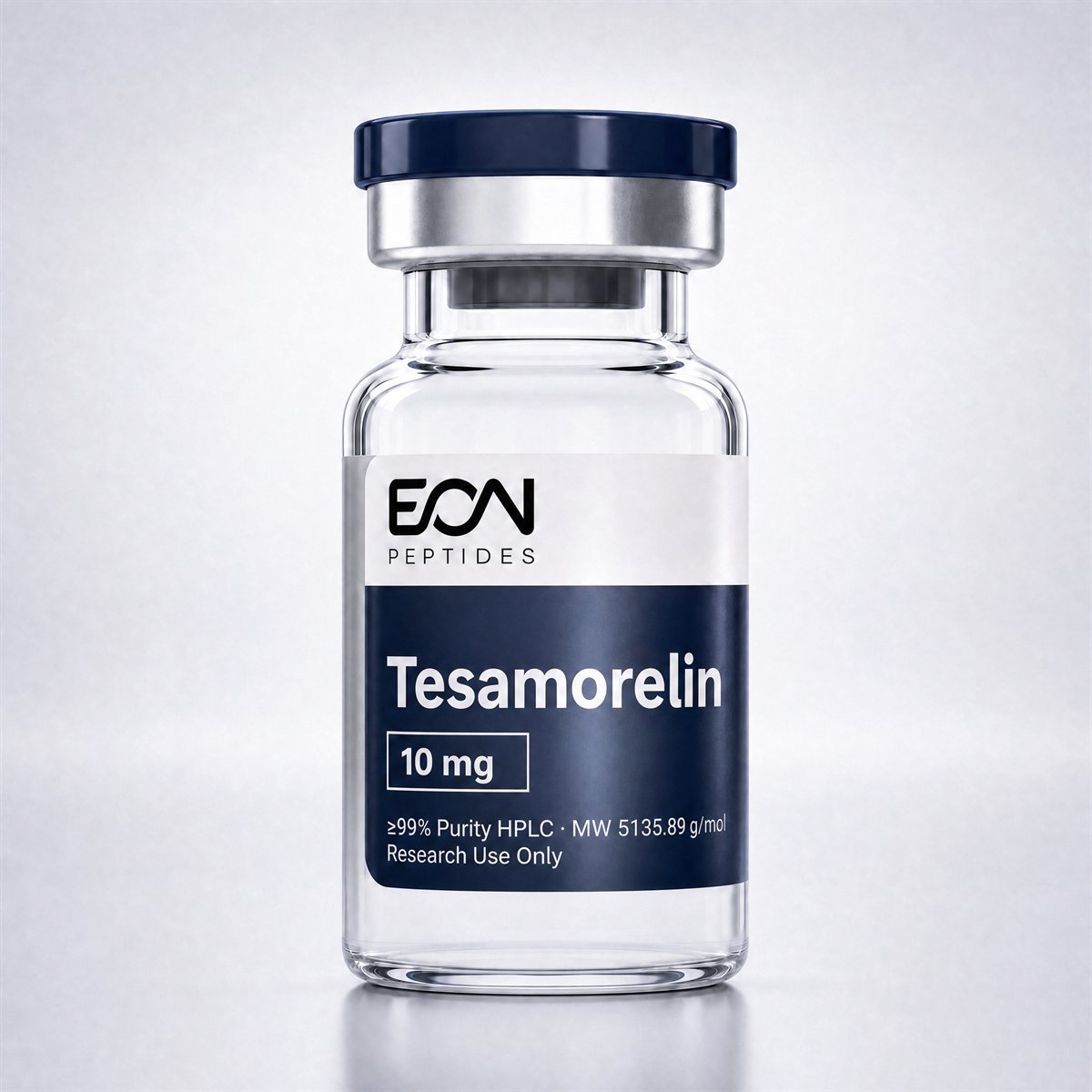
Tesamorelin is a synthetic version of growth hormone releasing hormone, or GHRH. The sequence matches the full 44 amino acid human hormone. A chemical group added to one end protects it from an enzyme called DPP-4, which would otherwise break it down quickly. Research has measured growth hormone output and how fat tissue is distributed in study models.
Synthetic GHRH(1-44) analog (trans-3-hexenoic acid-modified)
The pathways Tesamorelin acts on — and what each one does. The animation traces its signal outward from the compound to every target it engages.
Tesamorelin is a synthetic trans-3-hexenoic acid–modified analog of human GHRH(1-44). It binds and activates pituitary GHRH receptors, stimulating endogenous growth hormone (GH) secretion while preserving normal pulsatile GH release patterns — unlike exogenous GH administration.
Tesamorelin is studied for GH-mediated lipolytic signalling in visceral adipose tissue. GH is associated with hormone-sensitive lipase activity in adipocytes and free fatty acid release from visceral depots. The pharmaceutical formulation is approved under the brand name Egrifta; this research material is not.
Research examines tesamorelin in relation to brain structure and function via IGF-1 signalling. Studies in older adults with mild cognitive impairment report changes in regional grey matter volume and functional connectivity. GH/IGF-1 axis modulation is one hypothesised mechanism.
The main areas Tesamorelin is being studied for — and the study-reported figures behind them.
Visceral adipose signalling is the principal focus of tesamorelin research. The mechanism studied is GH-driven lipolysis in visceral depots, with limited effect on subcutaneous fat.
Regional brain volume and cognitive measures are a further area of research interest for this compound, studied via IGF-1 signalling.
Research model for studying GHRH receptor pharmacology, GH secretagogue effects, and downstream IGF-1 modulation in the context of GH deficiency states and aging-related GH decline.
Studies report triglyceride, non-HDL cholesterol and carotid intima-media thickness measures in HIV-positive adults, which is why the GH axis is studied against cardiovascular risk markers.
An interactive 3D model rendered from the compound record — rotate and explore its structure.
C221H366N72O67S
| Chemical Name | Trans-3-hexenoic acid–GRF(1-44)-amide |
| Sequence | Modified GHRH(1-44) analog (44 amino acids) |
| Molecular Weight | 5135.8 Da |
| Molecular Formula | C₂₂₁H₃₆₆N₇₂O₆₇S |
| Form | Lyophilized powder |
| Purity | ≥99% (HPLC verified) |
| Testing | Third-party HPLC, Mass Spec, Endotoxin |
| Storage | -20°C for long-term stability |
| Solubility | Water-soluble |
| COA | Included with every order |
Tesamorelin is a synthetic analog of human growth hormone–releasing hormone (GHRH), specifically a modified version of GHRH(1-44) with a trans-3-hexenoic acid group added to extend stability. Unlike exogenous growth hormone, tesamorelin acts on the pituitary to release endogenous GH, preserving the pulsatile release pattern and the feedback regulation that exogenous GH bypasses.
Yes. Tesamorelin is FDA-approved under the brand name Egrifta (approved 2010) for treatment of excess abdominal fat (lipodystrophy) in HIV-positive adults receiving antiretroviral therapy. This is the only approved indication. Research-grade tesamorelin sold here is for in vitro research purposes only and is not the approved pharmaceutical product.
Tesamorelin is studied for GH-mediated activation of hormone-sensitive lipase in visceral adipose depots specifically, rather than subcutaneous fat. That depot selectivity is the property of research interest.
Emerging research is exploring tesamorelin's potential effects on brain structure and cognitive function via elevated IGF-1 signaling. Brain volume and verbal memory measures in cognitive models are an active area of investigation for this compound.
Tesamorelin is not approved for human use and this material is supplied exclusively for in vitro laboratory research. Handling precautions are the same as for any research peptide; no human safety profile is offered for the material sold here.
Lyophilized tesamorelin should be stored at -20°C and protected from moisture and light. The trans-3-hexenoic acid modification raises resistance to dipeptidyl peptidase IV (DPP-IV) cleavage compared to native GHRH, but the material should still be handled carefully to preserve biological activity.
Not for human or veterinary use. For in-vitro laboratory research only. These statements have not been evaluated by the FDA; this product is not intended to diagnose, treat, cure, or prevent any disease. Sold exclusively to qualified researchers and institutions.