Sarcoidosis Small-Fiber Neuropathy
ARA 290 is studied in small-fiber neuropathy models, including neuropathic symptom scores and physical-function measures in sarcoidosis research.

EPO-derived 11-mer · innate repair receptor agonist
Free Shipping on orders over $200
Scan the QR code on any vial to verify its batch, COA, and origin in seconds. Secure traceability from our lab to your bench.
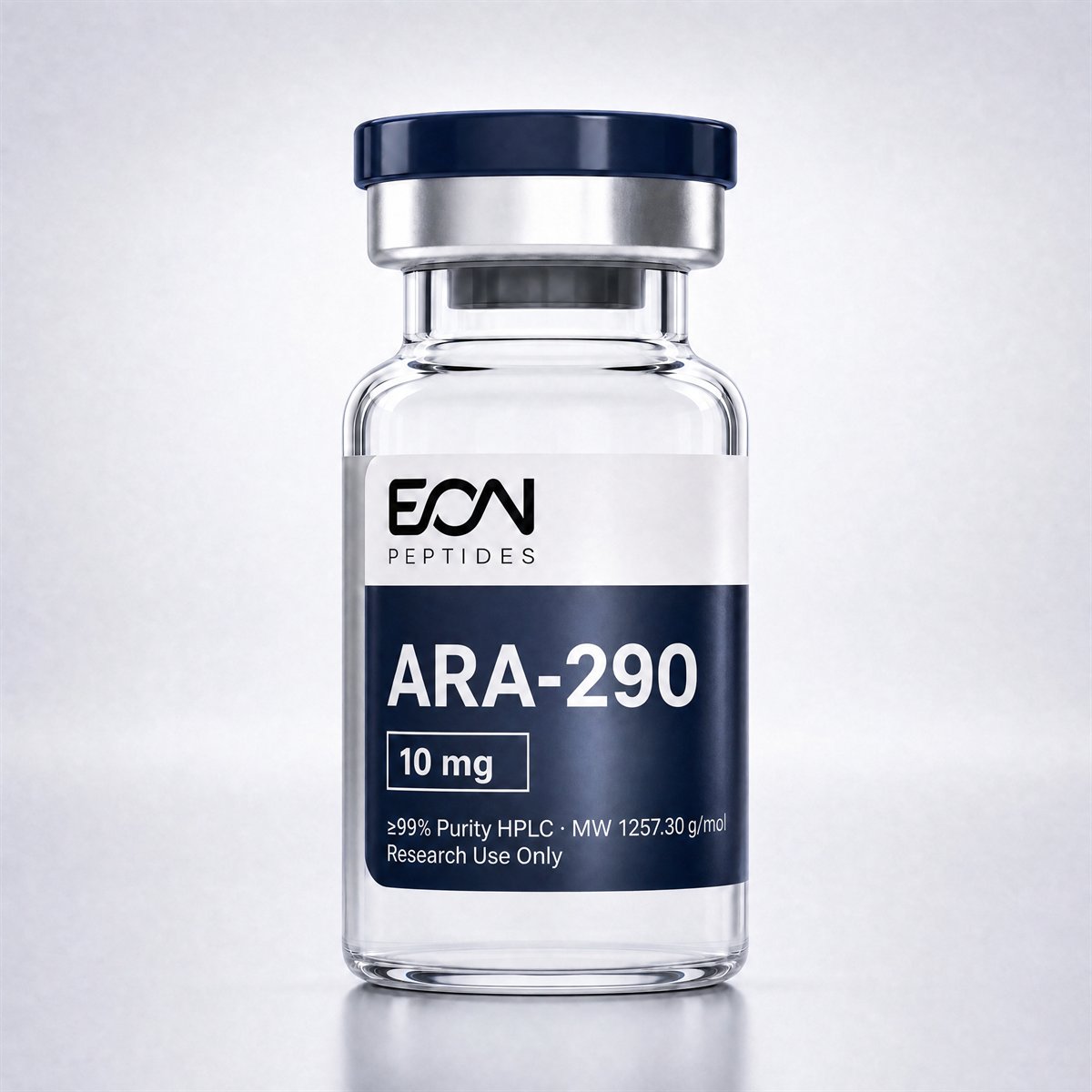
ARA-290 is also called cibinetide. It is a peptide made of 11 amino acids, taken from one section of erythropoietin. That is the hormone that drives red blood cell production. ARA-290 was designed to keep signalling at the innate repair receptor while leaving out the red blood cell effect. Research has measured its activity at that receptor, a two-part complex, and examined nerve and inflammation endpoints.
EPO helix-B surface derived 11-amino-acid peptide
The pathways ARA-290 acts on — and what each one does. The animation traces its signal outward from the compound to every target it engages.
ARA-290 (cibinetide) is an 11-amino-acid peptide engineered from the helix-B surface of erythropoietin (EPO). It selectively activates the innate repair receptor (IRR) — a heterocomplex of the EPO receptor and the β-common receptor (CD131) — without engaging the classical receptor that drives red-cell production.
Through the innate repair receptor, lower pro-inflammatory signalling and markers of its resolution have been measured, alongside reduced collateral tissue damage in the same models.
IRR activation engages JAK2/STAT3, PI3K/Akt and anti-apoptotic Bcl-2-family pathways, with cell survival and small-fibre measures recorded despite the peptide's very short plasma half-life.
The main areas ARA-290 is being studied for — and the study-reported figures behind them.
ARA 290 is studied in small-fiber neuropathy models, including neuropathic symptom scores and physical-function measures in sarcoidosis research.
Over a 28-day exposure, neuropathic symptom scores and small-fibre measures were recorded, including corneal nerve fibre density.
In rodent models, mechanical and cold allodynia thresholds were recorded over 20 weeks alongside spinal microglia response, with a dose-dependent relationship reported.
ARA 290 was engineered from EPO's tertiary structure to engage the innate repair receptor selectively, without the erythropoietic activity of native EPO.
An interactive 3D model rendered from the compound record — rotate and explore its structure.
C55H89N19O20
| Chemical Name | ARA-290 (Cibinetide) |
| Sequence | pGlu-Glu-Gln-Leu-Glu-Arg-Ala-Leu-Asn-Ser-Ser (11 aa) |
| Molecular Weight | 1,257.3 Da |
| Molecular Formula | C₅₅H₈₉N₁₉O₂₀ |
| CAS Number | 1208243-50-8 |
| Form | Lyophilized powder |
| Purity | ≥99% (HPLC verified) |
| Testing | Third-party HPLC, Mass Spec, Endotoxin |
| Storage | -20°C for long-term stability |
| Solubility | Sterile or bacteriostatic water |
| COA | Included with every order |
ARA-290 (cibinetide) is a synthetic 11-amino-acid peptide engineered from the helix-B surface domain of erythropoietin (EPO). It was designed to engage the innate repair receptor selectively — without the red-blood-cell-stimulating activity of native EPO.
The IRR is a heterocomplex of the EPO receptor and the β-common receptor (CD131). It is the arm of EPO signalling distinct from the classical homodimeric EPO receptor that controls erythropoiesis. ARA-290 selectively activates it.
No. ARA-290 is non-erythropoietic — it does not engage the receptor pathway that drives red-cell production, so it does not raise hematocrit. That receptor separation is the central rationale behind its design.
ARA 290 is studied in models of small-fiber neuropathy, where the measures examined include neuropathic symptom scores, corneal nerve fiber density and small nerve fiber regrowth. Preclinical models also examine long-term neuropathic pain behaviors.
No. Research-grade ARA-290 sold here is strictly for in vitro laboratory research and analytical applications. It is not a drug and is not intended for human or veterinary use, consumption, or any clinical application.
Not for human or veterinary use. For in-vitro laboratory research only. These statements have not been evaluated by the FDA; this product is not intended to diagnose, treat, cure, or prevent any disease. Sold exclusively to qualified researchers and institutions.