Selective GH Secretagogue
First pentapeptide GH secretagogue characterised with GH release but no accompanying cortisol, ACTH or prolactin rise — the selectivity benchmark for GHS research.

GH Pulse Studies
Free Shipping on orders over $200
Scan the QR code on any vial to verify its batch, COA, and origin in seconds. Secure traceability from our lab to your bench.
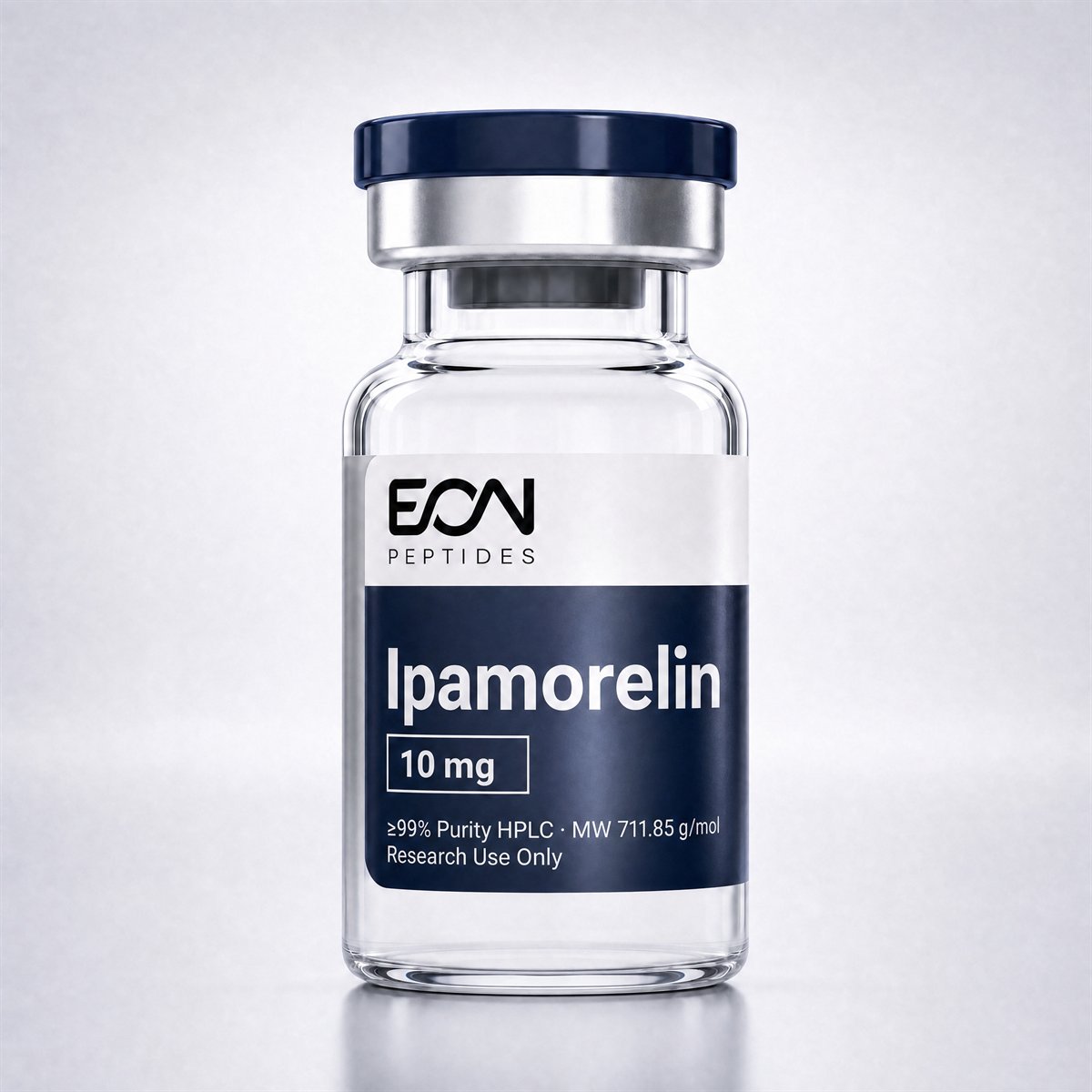
Ipamorelin is a peptide made of five amino acids. It binds GHS-R, the growth hormone secretagogue receptor. Research has measured how growth hormone is released after exposure. Selectivity is the main point of study. Compared to older compounds in the same class, it shows little effect on cortisol, prolactin, and ACTH.
Pentapeptide GH secretagogue / GHSR-1a agonist
The pathways Ipamorelin acts on — and what each one does. The animation traces its signal outward from the compound to every target it engages.
Ipamorelin selectively binds Growth Hormone Secretagogue Receptor 1a (GHSR-1a) on anterior pituitary somatotrophs, with GH release measured in a concentration-dependent manner. It acts via the same receptor as ghrelin but with greater selectivity and without the appetite-related off-target activity.
Unlike GHRP-2 and GHRP-6, ipamorelin does not raise ACTH, cortisol or prolactin at concentrations that produce substantial GH release. This was characterised in escalation studies and marks ipamorelin as the first pentapeptide GH secretagogue with this selectivity profile.
GH release is measured in discrete, pulsatile bursts resembling endogenous GH secretion physiology. That pattern differs from continuous GH elevation and is maintained across repeated exposures.
The main areas Ipamorelin is being studied for — and the study-reported figures behind them.
First pentapeptide GH secretagogue characterised with GH release but no accompanying cortisol, ACTH or prolactin rise — the selectivity benchmark for GHS research.
In human study populations, GH was measured during early nocturnal sleep phases following ipamorelin, with no accompanying cortisol change — a model for GH secretion across sleep-wake cycles.
Dose-dependent bone growth observed in rat models: 52 vs 42 µm/day at effective doses, confirming GH-mediated downstream effects on skeletal tissue in preclinical studies.
Ipamorelin acts via a complementary receptor (GHSR-1a) to GHRH analogs like CJC-1295. Combination conditions are studied against GH pulse amplitude via the two pathways.
An interactive 3D model rendered from the compound record — rotate and explore its structure.
C38H49N9O5
How Ipamorelin clears from circulation, modeled from its documented ~~2 hours half-life. The curve draws as you scroll.
| Type | Pentapeptide GH secretagogue / GHSR-1a agonist |
| Sequence | Aib-His-D-2-Nal-D-Phe-Lys-NH₂ |
| CAS Number | 170851-70-4 |
| Molecular Weight | 711.9 g/mol |
| Amino Acids | 5 (pentapeptide) |
| Receptor Target | GHSR-1a (ghrelin receptor) |
| Plasma Half-Life | ~2 hours |
| Form | Lyophilized powder |
| Purity | ≥99% (HPLC verified) |
| Testing | Third-party HPLC, Mass Spec, Endotoxin |
| Storage | -20°C for up to 24 months |
| Solubility | Water-soluble |
| COA | Included with every order |
Ipamorelin is a synthetic pentapeptide (5 amino acids) that selectively binds the Growth Hormone Secretagogue Receptor 1a (GHSR-1a) — also known as the ghrelin receptor — on anterior pituitary somatotrophs. This triggers dose-dependent growth hormone release. It was developed by Novo Nordisk and characterised as the first pentapeptide GH secretagogue with a clean selectivity profile: GH release with no cortisol, ACTH, or prolactin elevation.
All three are GHSR-1a agonists acting on GH release. The distinction is selectivity: GHRP-6 and GHRP-2 raise cortisol, ACTH and prolactin alongside GH. Ipamorelin does not — even at concentrations producing maximum GH response. That makes it a cleaner research tool for isolating GH secretion without confounding stress-hormone activity. GHRP-6 also acts strongly on appetite via hypothalamic pathways; ipamorelin's is minimal.
Preclinical research describes concentration-dependent GH release (ED50 ~80 nmol/kg), no cortisol or prolactin change, and bone growth rate 24% above control (52 vs 42 µm/day) in rat models. Pharmacokinetic characterisation describes GH elevation during nocturnal sleep phases with a ~2-hour half-life and peak GH response at approximately 40 minutes. All preclinical findings should not be extrapolated to human use.
Ipamorelin (GHSR-1a agonist) and CJC-1295 (GHRH-R agonist) work through complementary and synergistic receptor pathways. GHRH and GH secretagogues act at different pituitary receptor sites and their combination produces additive or supra-additive GH pulse amplitude responses. Research protocols studying this combination aim to maximize GH pulse magnitude while preserving pulsatility — an area of active preclinical investigation.
No. Ipamorelin is not FDA-approved for any indication. It is classified as a research compound and is sold exclusively for in vitro research purposes. No Phase 3 clinical trials have been completed. Some compounding pharmacies have included it in formulations, which the FDA has flagged. It is not intended for human therapeutic use.
Lyophilized ipamorelin should be stored at -20°C for long-term stability (up to 24 months). Avoid repeated freeze-thaw cycles. The pentapeptide structure is relatively stable in lyophilized form but degrades more rapidly in solution.
Not for human or veterinary use. For in-vitro laboratory research only. These statements have not been evaluated by the FDA; this product is not intended to diagnose, treat, cure, or prevent any disease. Sold exclusively to qualified researchers and institutions.