Dual-Pathway GH Response
Simultaneous GHRH-R and GHSR-1a activation produces additive GH pulse amplification — a model for studying maximal pituitary GH secretory capacity while maintaining physiologic pulse architecture.

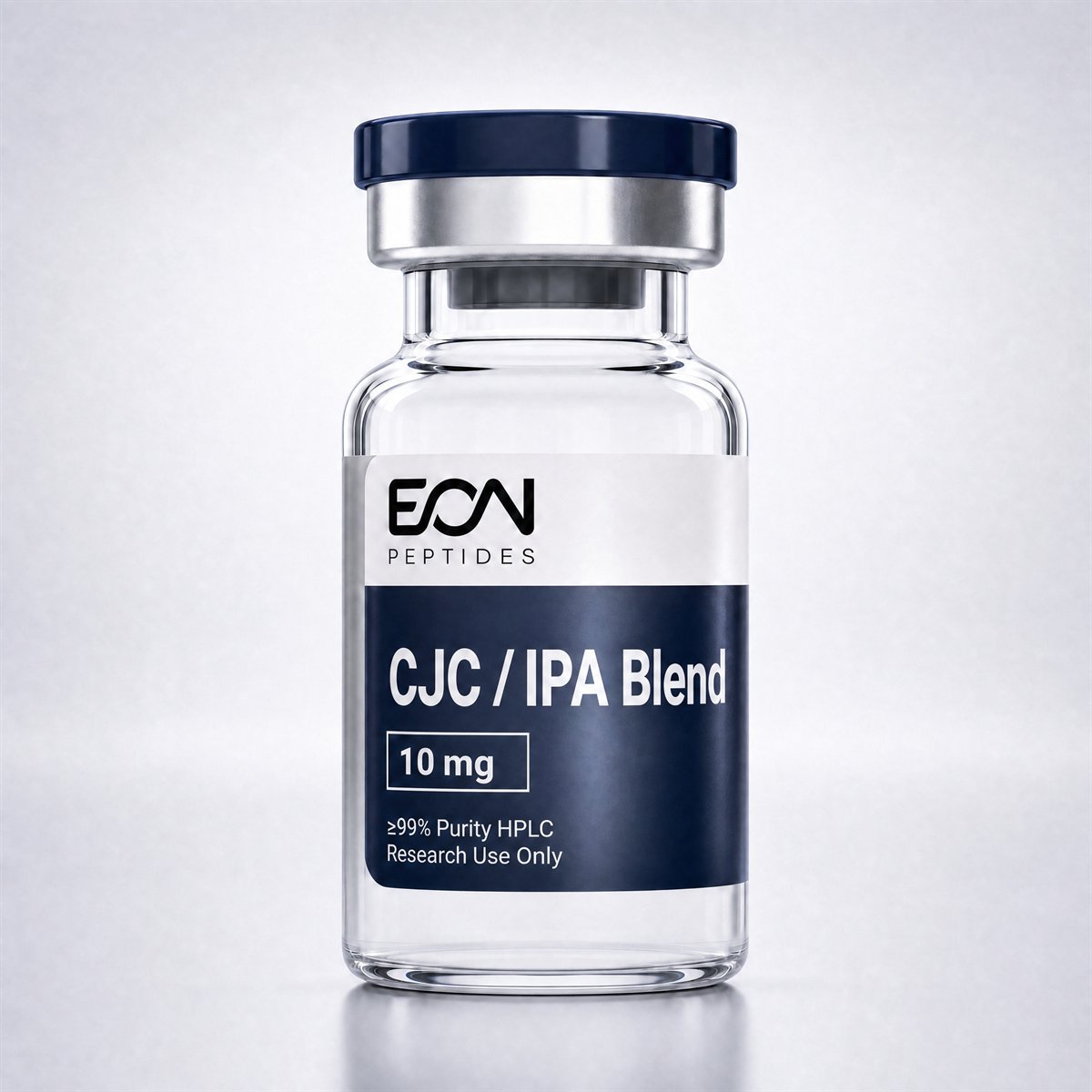
Two-peptide blend · GHRH-R and GHS-R pathways
Free Shipping on orders over $200
Scan the QR code on any vial to verify its batch, COA, and origin in seconds. Secure traceability from our lab to your bench.
This blend pairs CJC-1295 with ipamorelin. Both relate to growth hormone, but they act at different receptors. CJC-1295 copies GHRH, the hormone that signals release. Ipamorelin acts at a separate receptor called GHS-R. Research has measured what happens when both are present compared to either one alone. Pairing a GHRH analog with a secretagogue is a common combination in growth hormone research.
Dual-component blend: GHRH-R agonist (CJC-1295, Modified GRF 1-29) + GHSR-1a agonist pentapeptide (Ipamorelin)
The pathways CJC / IPA Blend acts on — and what each one does. The animation traces its signal outward from the compound to every target it engages.
CJC-1295 (Modified GRF 1-29) is the GHRH receptor agonist component. It binds GHRH-R on pituitary somatotrophs, with cAMP production and GH synthesis measured. The four DPP-IV-resistant amino acid substitutions extend bioavailability to ~30 minutes, giving a longer window of GHRH-R activation per administration.
Ipamorelin is the GHSR-1a (ghrelin receptor) agonist component. It binds a distinct receptor population on somatotrophs via a phospholipase C / IP3 intracellular pathway — separate from the cAMP route used by GHRH. This complementary signaling allows both pathways to be active simultaneously without receptor competition.
When GHRH-R and GHSR-1a are activated simultaneously, GH pulse amplitude above either compound alone has been recorded. Preclinical data describe an additive interaction between the two pathways at the pituitary.
The main areas CJC / IPA Blend is being studied for — and the study-reported figures behind them.
Simultaneous GHRH-R and GHSR-1a activation produces additive GH pulse amplification — a model for studying maximal pituitary GH secretory capacity while maintaining physiologic pulse architecture.
The short half-lives of both components (~30 min for CJC-1295; ~2 hr for ipamorelin) preserve pulsatile GH release — enabling research into GH pulse physiology without continuous baseline elevation.
CJC-1295/Ipamorelin is studied as a higher-selectivity comparator to CJC-1295/GHRP-6 combinations — GH response amplitude is retained while cortisol and prolactin co-secretion associated with GHRP-6 is absent.
GHRH-R signals via cAMP/PKA while GHSR-1a signals via PLC/IP3 — distinct second messenger cascades that do not compete. This orthogonal mechanism makes the combination a research model for studying receptor cross-talk in neuroendocrine signaling.
An interactive 3D model rendered from the compound record — rotate and explore its structure.
BLEND
How CJC / IPA Blend clears from circulation, modeled from its documented ~~20–30 minutes half-life. The curve draws as you scroll.
| Strength | 10mg |
| Molecular Formula | BLEND |
| Molecular Weight | N/A (Blend) |
| Purity | >99% (HPLC) |
| Form | Lyophilized Powder |
| Blend Components | CJC-1295 (Modified GRF 1-29) + Ipamorelin |
| CJC-1295 Type | GHRH analog — GHRH-R agonist (no DAC modification) |
| Ipamorelin Type | Pentapeptide GH secretagogue — GHSR-1a agonist |
| CJC-1295 MW | 3,367.9 g/mol |
| Ipamorelin MW | 711.9 g/mol |
| CJC Half-Life | ~20–30 minutes |
| Ipamorelin Half-Life | ~2 hours |
| Form | Lyophilized powder (co-lyophilized blend) |
| Purity | ≥99% each component (HPLC verified) |
| Testing | Third-party HPLC, Mass Spec, Endotoxin |
| Storage | -20°C for up to 24 months |
| Solubility | Water-soluble |
| COA | Included with every order |
| Appearance | White to off-white powder |
The CJC-1295/Ipamorelin blend combines two peptides acting on pituitary GH release through distinct receptor systems. CJC-1295 (Modified GRF 1-29) activates GHRH receptors (GHRH-R) via the cAMP/PKA intracellular pathway. Ipamorelin activates GHSR-1a (ghrelin receptors) via the PLC/IP3 pathway. Because these are separate receptor populations using different second messenger systems, simultaneous activation has been recorded producing larger GH pulses than either alone, without receptor competition.
Both ipamorelin and GHRP-6 are GHSR-1a agonists, but ipamorelin is more selective. GHRP-6 co-elevates cortisol, ACTH and prolactin — stress and pituitary hormones that confound research readouts. Ipamorelin gives a comparable GH response without those confounders, which is why the CJC-1295/Ipamorelin combination is used where cortisol and prolactin need to be excluded as variables.
Pulsatile GH secretion means GH is released in discrete bursts rather than a steady continuous stream. Endogenously, this occurs 6–12 times per day, with the largest pulses during slow-wave sleep. The pulsatile pattern is important because GH receptor sensitivity, downstream IGF-1 production, and metabolic effects all depend on the pulse amplitude and inter-pulse interval. CJC-1295/Ipamorelin preserves this pulsatile architecture (due to short half-lives) — making it a tool for studying GH pulse physiology rather than pharmacological continuous GH replacement.
The combination has not been characterised as a single formulation. The rationale is derived from: (1) ipamorelin pharmacology describing GHSR-1a selective GH stimulation; (2) CJC-1295 pharmacokinetic characterisation describing GHRH-R-mediated GH/IGF-1 elevation; and (3) preclinical work describing additive GH responses when GHRH and GH secretagogues are co-administered.
No. Neither CJC-1295 without DAC nor ipamorelin is FDA-approved for any indication, and the combination has no regulatory approval. Both are research compounds classified as not intended for human therapeutic use. This blend is sold exclusively for in vitro research purposes.
The lyophilized powder blend should be stored at -20°C for long-term stability. Avoid repeated freeze-thaw cycles and protect from light. Both components maintain stability in lyophilized form; CJC-1295 is relatively more sensitive to DPP-IV degradation in solution due to the absence of albumin binding.
Not for human or veterinary use. For in-vitro laboratory research only. These statements have not been evaluated by the FDA; this product is not intended to diagnose, treat, cure, or prevent any disease. Sold exclusively to qualified researchers and institutions.