Neuroprotection & Oxidative Stress
In vitro work reports dose-dependent suppression of ROS accumulation and reduced necrotic cell death in neuronal cell models exposed to oxidative stress.

Tripeptide studied in neuronal oxidative-stress models
Free Shipping on orders over $200
Scan the QR code on any vial to verify its batch, COA, and origin in seconds. Secure traceability from our lab to your bench.
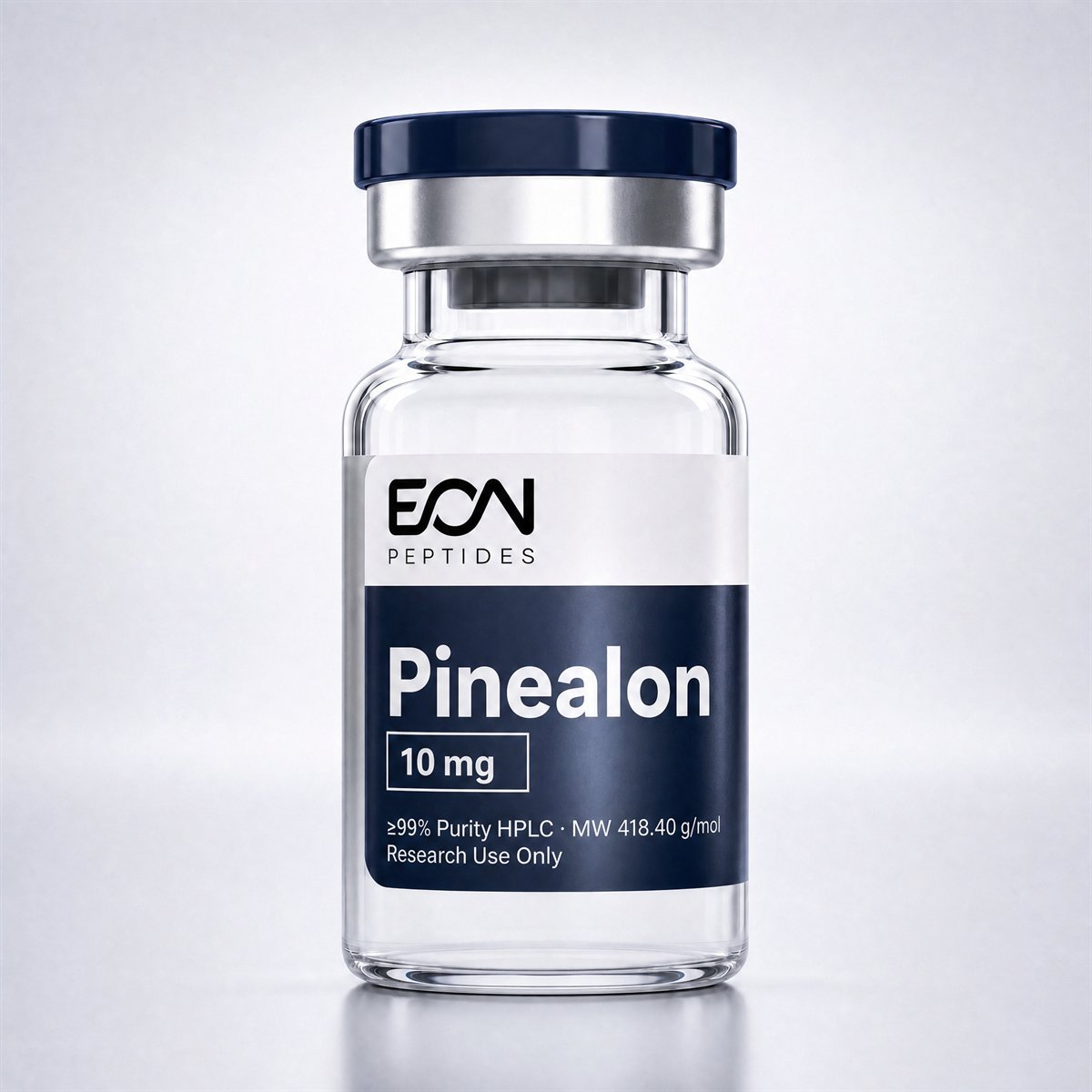
Pinealon is a peptide made of three amino acids. It came out of the same pineal gland research as Epithalon. Studies have measured neuron survival and oxidative damage in low-oxygen and stress models. Peptides this short are studied for direct interaction with DNA rather than for binding a receptor. That is an unusual mechanism.
Copper-free EDR short-peptide bioregulator (Glu-Asp-Arg tripeptide)
The pathways Pinealon acts on — and what each one does. The animation traces its signal outward from the compound to every target it engages.
Pinealon is a short, positively charged tripeptide (Glu-Asp-Arg). Research from the Khavinson group proposes that peptides of this class interact electrostatically with chromatin and the promoter regions of specific genes, influencing transcription of neuroprotective and antioxidant proteins.
In vitro studies report that pinealon produces dose-dependent restriction of reactive oxygen species (ROS) accumulation in cerebellar granule cells, neutrophils, and PC12 cells under oxidative stress, alongside a decrease in necrotic cell death.
Research in prenatal and aged-animal models has examined pinealon's neuroprotective profile, including greater resistance of cerebellar neurons to oxidative stress and reported changes in neurotrophic-factor expression.
The main areas Pinealon is being studied for — and the study-reported figures behind them.
In vitro work reports dose-dependent suppression of ROS accumulation and reduced necrotic cell death in neuronal cell models exposed to oxidative stress.
Animal studies examined pinealon in prenatal hyperhomocysteinemia, reporting changes in offspring cognitive measures and greater cerebellar neuron resistance to oxidative stress.
EDR-class peptides are studied as short-peptide regulators of gene expression and protein synthesis, with proposed binding to specific DNA promoter regions.
In vivo research investigated regulatory peptides, including pinealon, for their effect on brain-neuron survival under hypoxic conditions.
An interactive 3D model rendered from the compound record — rotate and explore its structure.
C15H26N6O8
| Chemical Name | Pinealon (Glu-Asp-Arg) |
| Sequence | L-Glutamyl-L-Aspartyl-L-Arginine (EDR tripeptide) |
| Molecular Weight | 418.4 g/mol |
| Molecular Formula | C₁₅H₂₆N₆O₈ |
| Form | Lyophilized powder |
| Purity | ≥99% (HPLC verified) |
| Testing | Third-party HPLC, Mass Spec, Endotoxin |
| Storage | -20°C for long-term stability |
| Solubility | Water-soluble |
| COA | Included with every order |
Pinealon is a synthetic tripeptide composed of L-glutamic acid, L-aspartic acid, and L-arginine (Glu-Asp-Arg, often abbreviated EDR). It belongs to the class of short-peptide "bioregulators" developed within Professor Vladimir Khavinson's research program at the St. Petersburg Institute of Bioregulation and Gerontology, and is studied for its proposed effects on gene expression and neuroprotection.
The leading mechanistic hypothesis is that, as a short and positively charged peptide, Pinealon can interact electrostatically with chromatin and the promoter regions of specific genes, influencing the transcription of neuroprotective and antioxidant proteins. This is described as an epigenetic-level mode of action, distinct from neurotransmitter or receptor-based compounds. It remains an active area of investigation.
In vitro studies report that Pinealon produces a dose-dependent reduction in reactive oxygen species (ROS) accumulation in cerebellar granule cells, neutrophils, and PC12 cells exposed to oxidative stress, and is associated with decreased necrotic cell death and increased cell viability in those models.
No. Pinealon is not approved by the FDA or any other regulatory authority for human therapeutic use. The published literature is preclinical and in vitro. Research-grade Pinealon sold here is intended strictly for in vitro laboratory research and is not for human or veterinary use.
Pinealon and Epitalon are both short-peptide bioregulators studied by the same research group. They share the proposed "peptide–DNA interaction" mechanistic framework but differ in amino-acid sequence and the gene targets and research models they are associated with. Pinealon (EDR) is most often studied in neuroprotection and oxidative-stress contexts.
Lyophilized Pinealon should be stored at -20°C and protected from moisture and light for long-term stability, preserving peptide integrity.
Not for human or veterinary use. For in-vitro laboratory research only. These statements have not been evaluated by the FDA; this product is not intended to diagnose, treat, cure, or prevent any disease. Sold exclusively to qualified researchers and institutions.