Wound Closure Models
Studied for dermal wound closure, scarring and organized collagen deposition in preclinical wound models.

Cell Migration Studies
Free Shipping on orders over $200
Scan the QR code on any vial to verify its batch, COA, and origin in seconds. Secure traceability from our lab to your bench.
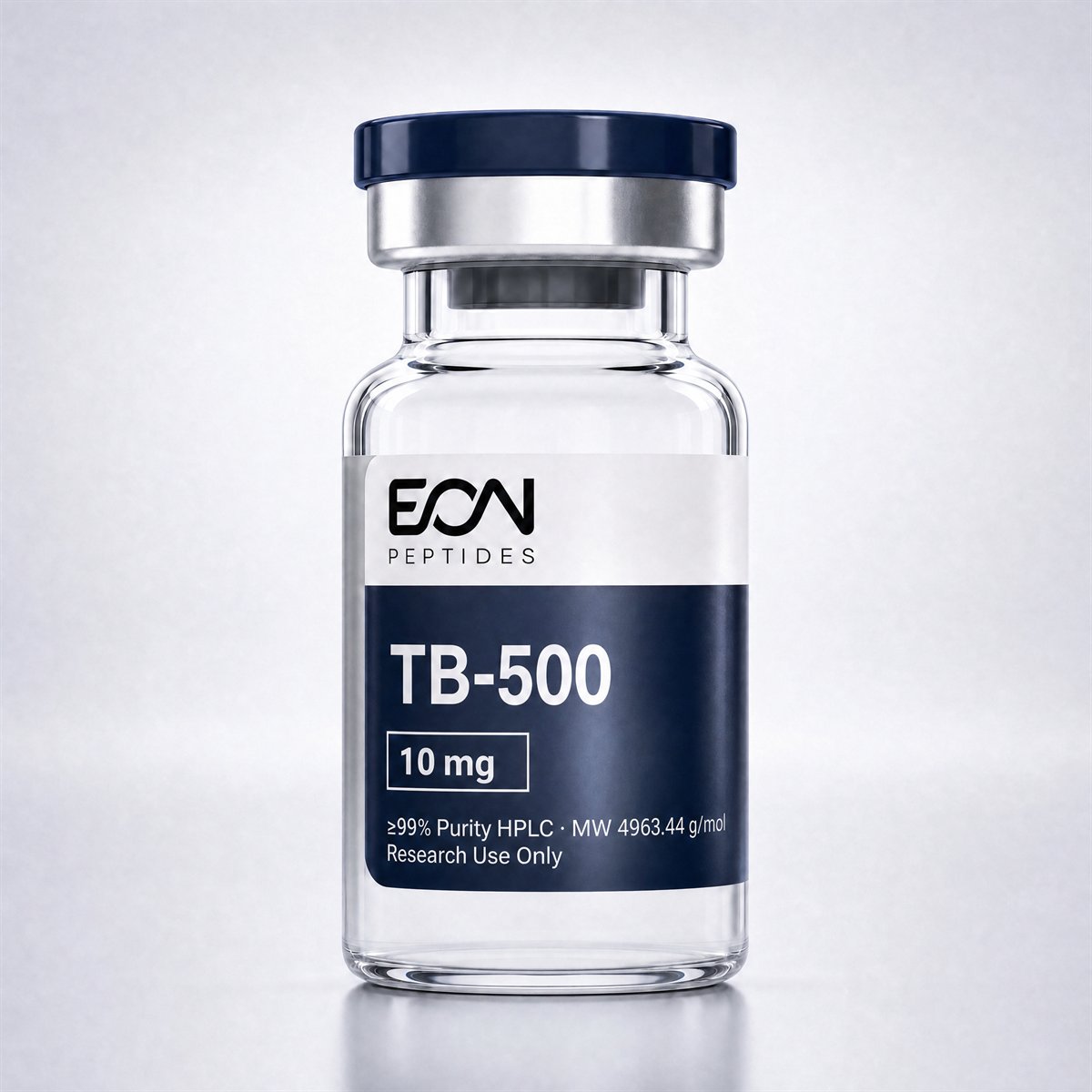
TB-500 is a fragment of thymosin beta-4, a protein found in most human cell types. The fragment reproduces the section that binds actin, the protein that gives cells their shape and allows them to move. Studies have measured how cells migrate in culture and how new blood vessels form under those conditions.
43-amino acid fragment of Thymosin Beta-4 (Tβ4) active region
The pathways TB-500 acts on — and what each one does. The animation traces its signal outward from the compound to every target it engages.
TB-500 binds G-actin monomers, with actin polymerisation and cell migration toward injury sites measured in preclinical models. This is the mechanism most often characterised.
In cardiac research, TB-500 is studied for integrin-linked kinase (ILK) signalling and cardiac progenitor cell migration.
Lower pro-inflammatory cytokines and altered macrophage activity are measured, with the immune profile shifting from inflammatory to reparative-phase markers in preclinical wound models.
The main areas TB-500 is being studied for — and the study-reported figures behind them.
Studied for dermal wound closure, scarring and organized collagen deposition in preclinical wound models.
Studied for cardiac cell migration via ILK activation in post-infarction models.
Studied in corneal epithelial wound closure and inflammation in ocular surface models.
Studied in muscle, tendon and ligament models through actin-mediated cell migration and fibrotic scoring.
An interactive 3D model rendered from the compound record — rotate and explore its structure.
C212H350N56O78S
| Active Fragment | Thymosin Beta-4 (Tβ4) active region |
| Amino Acids | 43-amino acid peptide |
| Molecular Weight | 4,963 Da |
| Form | Lyophilized powder (10mg) |
| Purity | ≥99% (HPLC verified) |
| Testing | Third-party HPLC, Mass Spec, Endotoxin |
| Storage | -20°C for long-term stability |
| Solubility | Water-soluble |
| COA | Included with every order |
TB-500 is a synthetic peptide corresponding to the active region of Thymosin Beta-4 (Tβ4), a 43-amino acid protein naturally found in all nucleated cells. Tβ4 is studied for its role in cell migration, differentiation and tissue remodelling through its interaction with the actin cytoskeleton.
TB-500 contains the active fragment of the full Thymosin Beta-4 protein. While Tβ4 is the complete 43-amino acid sequence, TB-500 focuses on the region responsible for actin binding and cell migration properties. Both share the same core mechanism of action.
TB-500 is not approved by the FDA or any regulatory agency for human use. It is a fragment of thymosin beta-4 supplied exclusively for in vitro laboratory research, and no safety profile in humans is established for the material sold here.
TB-500 is studied in preclinical models covering wound closure, cardiac tissue, corneal surface, muscle and tendon, and inflammatory signalling. Its primary mechanism — cell migration via actin regulation — is common to all of them.
Store lyophilized TB-500 at -20°C for long-term stability. Avoid repeated freeze-thaw cycles and protect from light.
No. TB-500 is not FDA approved for any indication. It is available exclusively for in vitro laboratory research. TB-500 has not received regulatory approval, and the material sold here is not the pharmaceutical formulation of thymosin beta-4.
Not for human or veterinary use. For in-vitro laboratory research only. These statements have not been evaluated by the FDA; this product is not intended to diagnose, treat, cure, or prevent any disease. Sold exclusively to qualified researchers and institutions.