Tendon, Muscle & Connective Tissue
BPC-157 and structurally related peptides are studied in preclinical tendon, muscle and bone models. Human data remains limited.

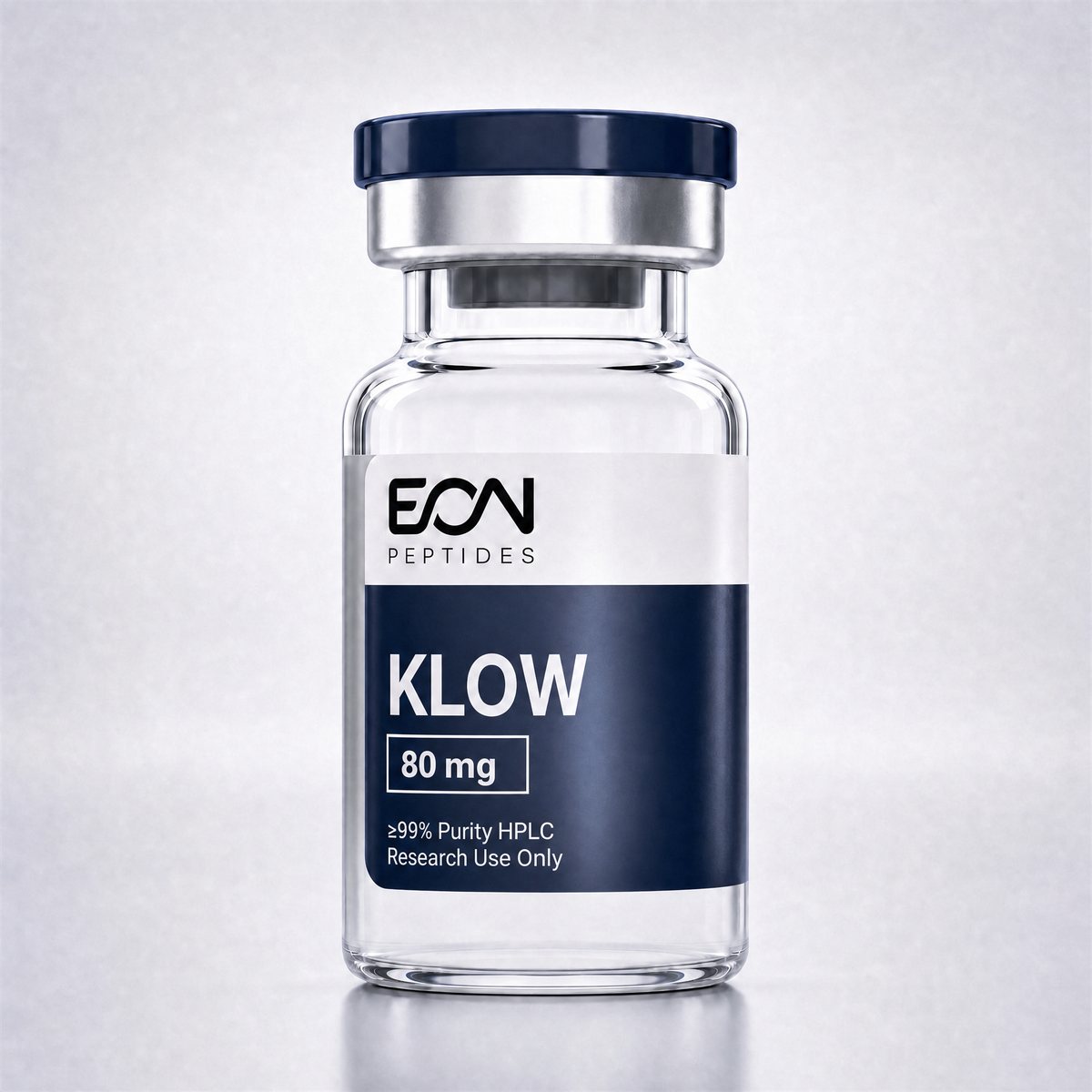
Four-peptide blend · 80 mg lyophilized
Free Shipping on orders over $200
Scan the QR code on any vial to verify its batch, COA, and origin in seconds. Secure traceability from our lab to your bench.
KLOW is a blend. Several peptides are combined and freeze-dried into a single 80 mg vial. Research on the individual ingredients covers collagen production, inflammation signaling, new blood vessel growth, and cell structure. Blends are supplied for researchers who want to test several pathways at once and compare the result against single compounds.
Four-peptide research blend (GHK-Cu, TB-500, BPC-157, KPV)
The pathways KLOW acts on — and what each one does. The animation traces its signal outward from the compound to every target it engages.
In preclinical research, BPC-157 is studied in skin, tendon, muscle and bone models through growth-factor upregulation and angiogenic signalling. TB-500 (a thymosin β-4 fragment) is studied for cell migration and fibrotic endpoints across several animal models.
GHK-Cu is a copper-binding tripeptide. Collagen and elastin synthesis, endothelial activity and fibroblast migration have been measured in cell culture following exposure, which is why it is a common reference compound in extracellular-matrix research.
KPV is the C-terminal tripeptide of α-MSH. In vitro work reports reduced NF-κB and MAP-kinase signalling at nanomolar concentrations, with correspondingly lower cytokine output in the same assays.
The main areas KLOW is being studied for — and the study-reported figures behind them.
BPC-157 and structurally related peptides are studied in preclinical tendon, muscle and bone models. Human data remains limited.
BPC-157, TB-500 and GHK-Cu are frequently used together in in-vitro and ex-vivo systems to probe endothelial activity and matrix gene expression.
GHK-Cu is a reference compound for collagen and elastin synthesis in fibroblast culture; the blend is studied in dermal models.
This peptide class is characterised by its signalling mechanisms; the human evidence base remains limited for all four components.
An interactive 3D model rendered from the compound record — rotate and explore its structure.
Mixture (GHK-Cu + TB-500 + BPC-157 + KPV)
| Product Type | Four-peptide research blend |
| Component 1 | GHK-Cu 50 mg — copper-binding tripeptide |
| Component 2 | TB-500 10 mg — thymosin β-4 fragment |
| Component 3 | BPC-157 10 mg — gastric pentadecapeptide |
| Component 4 | KPV 10 mg — α-MSH C-terminal tripeptide |
| Total Peptide Content | 80 mg per vial |
| Form | Lyophilized powder |
| Purity | ≥99% (HPLC verified) |
| Testing | Third-party HPLC, Mass Spec, Endotoxin |
| Storage | -20°C for long-term stability |
| COA | Included with every order |
KLOW is a four-peptide research blend combining GHK-Cu (50 mg), TB-500 (10 mg), BPC-157 (10 mg) and KPV (10 mg) — 80 mg of total peptide per vial. It groups short peptides that are individually studied in matrix, cell-migration and cytokine-signalling research.
BPC-157 is studied in tendon, muscle and bone models via growth-factor signalling; TB-500 (a thymosin β-4 fragment) in cell-migration and fibrosis models; GHK-Cu in collagen-synthesis and fibroblast models; KPV in NF-κB signalling models. The four span growth-factor, angiogenic, matrix and cytokine pathways.
Each component acts through a different mechanism. Combining them gives a single preparation that engages several pathways at once — angiogenic and growth-factor signalling (BPC-157, TB-500), extracellular matrix (GHK-Cu), and cytokine signalling (KPV) — which is why blends are used to compare multi-pathway against single-compound conditions.
No. None of the four components is an FDA-approved drug. BPC-157 specifically is not approved by the FDA or EMA, and a 2023 FDA Category 2 designation restricts injectable compounding in the United States. Research-grade KLOW is supplied strictly for in vitro laboratory research.
BPC-157, TB-500 and GHK-Cu are used in in-vitro systems, ex-vivo tissue explants and animal models, with endpoints such as endothelial-cell activity in angiogenesis assays, fibroblast matrix gene expression, cell migration and wound closure. KPV is used in inflammatory-signalling research. There is no human data for this blend.
Lyophilized KLOW should be stored at -20°C, protected from light and moisture, to preserve the integrity of all four peptides.
Not for human or veterinary use. For in-vitro laboratory research only. These statements have not been evaluated by the FDA; this product is not intended to diagnose, treat, cure, or prevent any disease. Sold exclusively to qualified researchers and institutions.