Melanogenesis Research
Research into MC1R-driven melanin synthesis, including UV-independent pigmentation and photoprotection models. Used as a pharmacological tool to dissect melanocyte signalling pathways and study disorders of pigmentation.

Melanin Production Studies
Free Shipping on orders over $200
Scan the QR code on any vial to verify its batch, COA, and origin in seconds. Secure traceability from our lab to your bench.
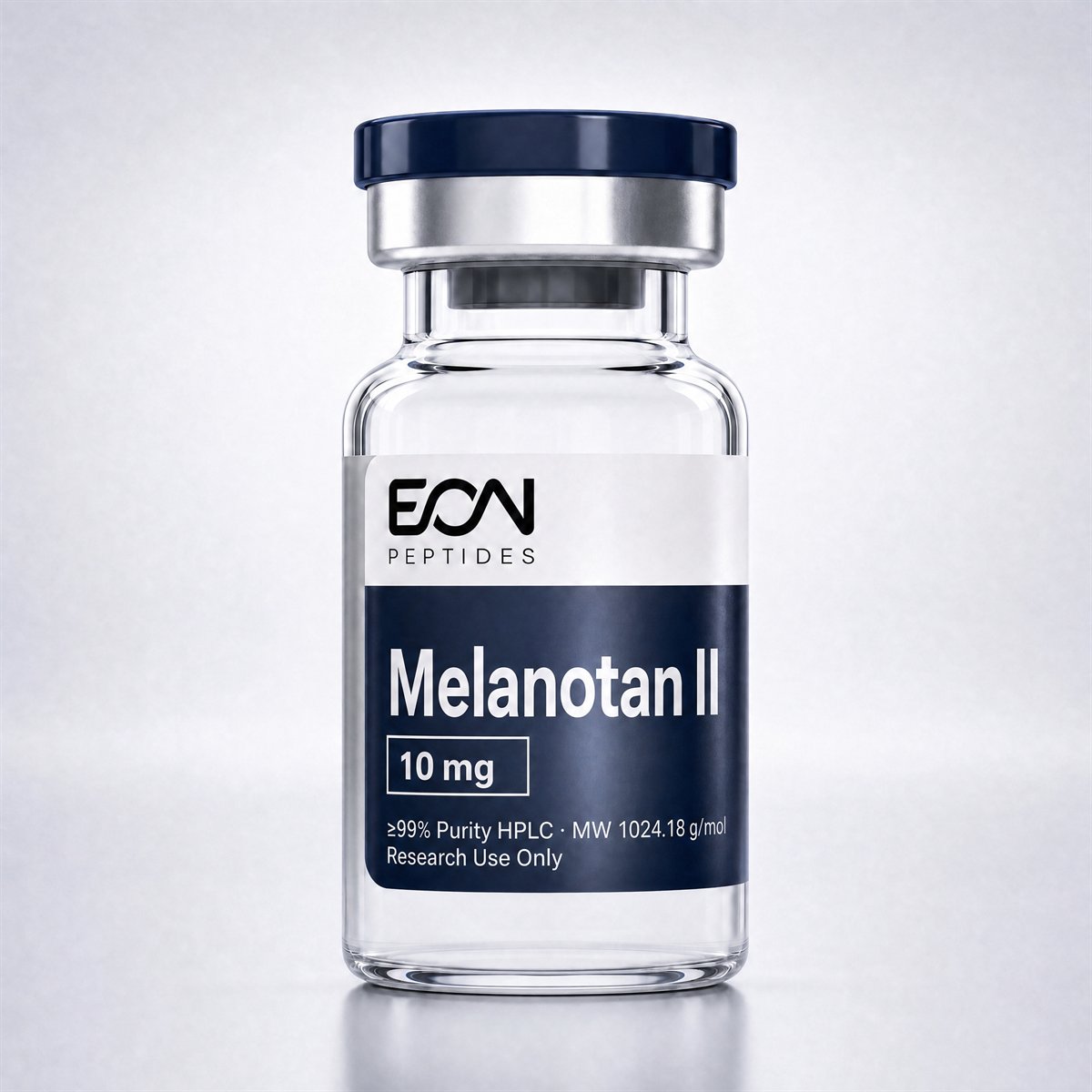
Melanotan II is a ring-shaped version of alpha-MSH, a hormone that signals pigment production. Closing the molecule into a ring makes it far more stable than the natural hormone. Studies have measured melanin production in pigment cell cultures and mapped which melanocortin receptors it binds and how strongly.
Cyclic heptapeptide melanocortin (α-MSH) analog
The pathways Melanotan II acts on — and what each one does. The animation traces its signal outward from the compound to every target it engages.
Melanotan II (MTII) activates MC1R on melanocytes, with intracellular cAMP production and melanogenesis — the synthesis of eumelanin (brown-black) pigment — measured downstream. This mechanism is studied as a model for UV-independent pigmentation and photoprotection pathways.
MTII's high-affinity binding at MC4R in the hypothalamus acts on both feeding-related and arousal-related signalling. MC4R knockout studies show these pathways are distinct. Its non-selective binding at MC3R and MC4R makes it a pharmacological tool for dissecting melanocortin circuits in energy balance research.
Unlike its derivative PT-141, Melanotan II is a non-selective melanocortin receptor agonist that activates MC1R through MC5R with varying affinities. This broad receptor activity makes it uniquely valuable as a pharmacological probe for studying the full melanocortin system in preclinical research, while also contributing to its broader side-effect profile.
The main areas Melanotan II is being studied for — and the study-reported figures behind them.
Research into MC1R-driven melanin synthesis, including UV-independent pigmentation and photoprotection models. Used as a pharmacological tool to dissect melanocyte signalling pathways and study disorders of pigmentation.
MTII is a key pharmacological tool in metabolic and energy-homeostasis research. In rodent models, MC4R activation is associated with lower food intake and higher energy expenditure; used extensively to validate the melanocortin hypothesis.
Preclinical research using MTII as a non-selective MC agonist probe contributed to the discovery of melanocortin-mediated arousal pathways, eventually leading to the development of PT-141 (bremelanotide) as a more selective MC4R-focused compound.
As a potent non-selective MC receptor agonist, MTII serves as a pharmacological tool for receptor binding studies, structure-activity relationship (SAR) research, and comparison of downstream signaling cascades across the five melanocortin receptor subtypes.
An interactive 3D model rendered from the compound record — rotate and explore its structure.
C50H69N15O9
| Chemical Name | Melanotan II (MTII) |
| Sequence | Ac-Nle-cyclo[Asp-His-D-Phe-Arg-Trp-Lys]-NH₂ |
| Molecular Weight | 1024.18 Da |
| Molecular Formula | C₅₀H₆₉N₁₅O₉ |
| Form | Lyophilized powder |
| Purity | ≥99% (HPLC verified) |
| Testing | Third-party HPLC, Mass Spec, Endotoxin |
| Storage | -20°C for long-term stability |
| Solubility | Water or bacteriostatic water |
| COA | Included with every order |
Melanotan II (MTII) is a synthetic cyclic heptapeptide analog of alpha-melanocyte stimulating hormone (α-MSH). It was originally developed at the University of Arizona in a research programme on synthetic melanocortins for pigmentation and photoprotection. MTII activates melanocortin receptors (MC1R through MC5R) with higher potency than endogenous α-MSH, making it a pharmacological research tool for the melanocortin system.
PT-141 (bremelanotide) is derived from Melanotan II through chemical modification. The difference is selectivity: Melanotan II is a non-selective agonist at MC1R, MC3R, MC4R and MC5R, with broader downstream activity including melanogenesis. PT-141 was engineered for narrower selectivity toward MC4R with reduced MC1R activity, so pigmentation activity is largely absent while central pathway activity remains.
No. Melanotan II has not been approved by the FDA, EMA, or any regulatory authority for human use. It is classified as a research chemical with no approved indication. Regulatory agencies including the FDA and UK MHRA have issued warnings about unlicensed MTII products marketed for tanning. It is available here exclusively for legitimate in vitro research purposes.
The melanocortin system consists of five G protein-coupled receptors (MC1R–MC5R) that respond to endogenous ligands including α-MSH, β-MSH, γ-MSH, and ACTH. This system regulates diverse functions including pigmentation (MC1R), adrenal steroidogenesis (MC2R), energy balance (MC3R, MC4R), and exocrine secretion (MC5R). MTII's high potency and non-selectivity across all MC receptors makes it an ideal pharmacological probe for pan-melanocortin system research and structure-activity relationship studies.
Due to MTII's broad, non-selective receptor activity, researchers and regulatory agencies have raised concerns about potential effects on melanocytic nevi (moles) and theoretical melanoma risk through excessive MC1R stimulation. Early human pilot studies reported significant adverse events including nausea, yawning, and spontaneous erection from MC4R stimulation. No long-term safety data from controlled clinical trials exists. These considerations make careful research design essential when working with MTII.
Lyophilized MTII should be stored at -20°C and protected from light and moisture. The cyclic structure with D-phenylalanine substitution provides greater proteolytic stability than linear α-MSH, but the material should still be handled and stored carefully to preserve receptor binding activity in research assays.
Not for human or veterinary use. For in-vitro laboratory research only. These statements have not been evaluated by the FDA; this product is not intended to diagnose, treat, cure, or prevent any disease. Sold exclusively to qualified researchers and institutions.