Sustained GH Elevation
A single administration was followed by GH 2–10× above baseline for 6+ days. Repeated-administration studies recorded IGF-1 above baseline for 28 days in adult study populations.

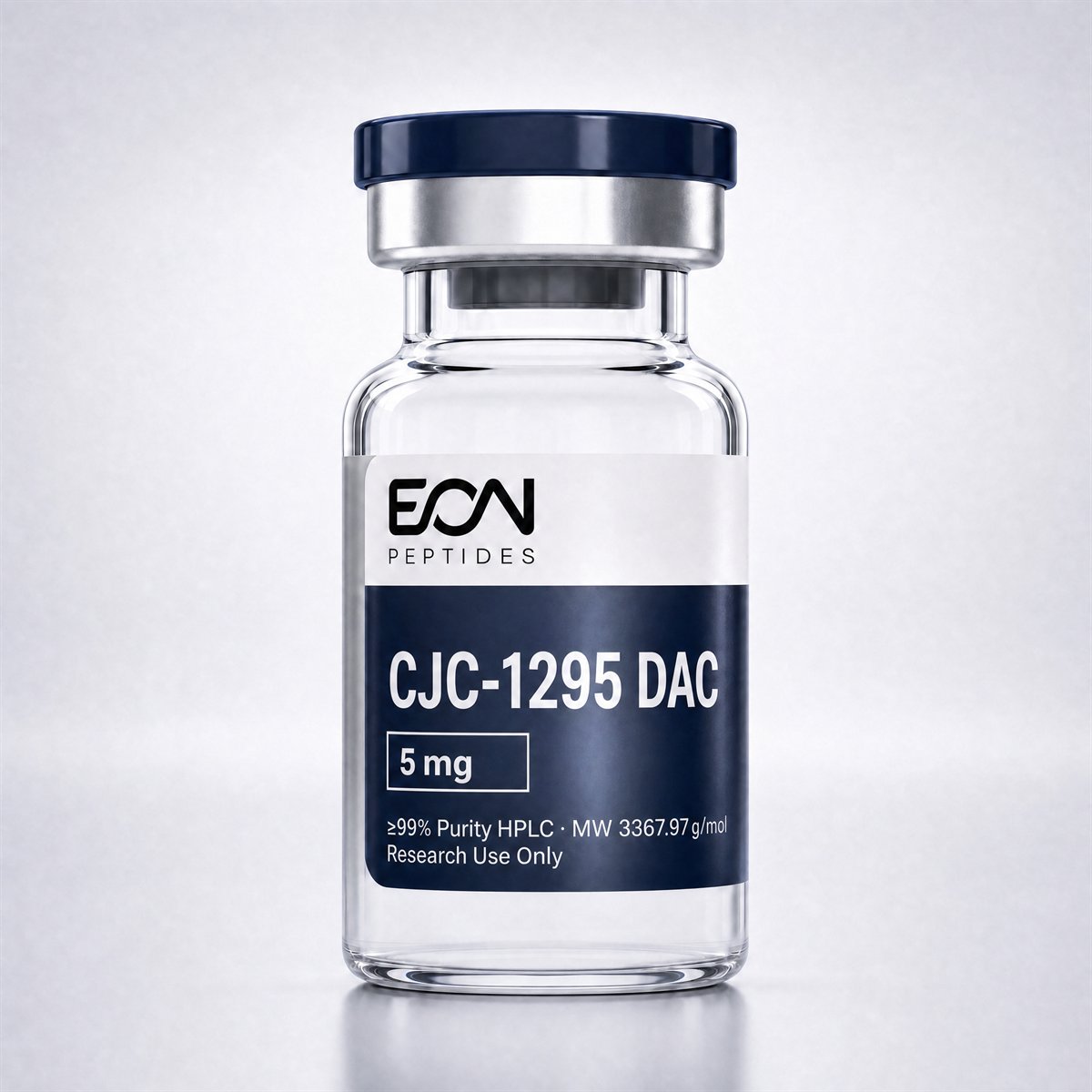
Long-acting GHRH analog · albumin-bound depot
Free Shipping on orders over $200
Scan the QR code on any vial to verify its batch, COA, and origin in seconds. Secure traceability from our lab to your bench.
CJC-1295 DAC is a modified version of GHRH, the hormone that signals growth hormone release. It carries a chemical linker called a DAC that attaches permanently to albumin in the blood. That attachment is the whole point of the modification. Studies have measured how long it stays active: roughly six to eight days, compared to about thirty minutes for the version without the linker.
Synthetic 30-amino-acid GHRH(1–29) analog with Drug Affinity Complex (DAC) albumin-binding modification
The pathways CJC-1295 DAC acts on — and what each one does. The animation traces its signal outward from the compound to every target it engages.
CJC-1295 DAC is a 30-amino acid analog of GHRH(1–29) with four substitutions that confer protease resistance. It binds and activates GHRH receptors on pituitary somatotrophs, acting on growth hormone synthesis and pulsatile release — the same signalling axis as endogenous GHRH, with a much longer duration.
The Drug Affinity Complex (DAC) is a maleimidopropionic acid group attached to Lys8 of the peptide. After injection, it covalently bonds to Cys34 of circulating serum albumin — eliminating DPP-IV cleavage and extending half-life from 7 minutes to 5.8–8.1 days. The albumin acts as a circulating depot, slowly releasing active peptide.
Sustained GH elevation is followed by hepatic insulin-like growth factor-1 (IGF-1) production. IGF-1 remains elevated 9–11 days from a single administration, with cumulative elevation recorded across repeated administrations.
The main areas CJC-1295 DAC is being studied for — and the study-reported figures behind them.
A single administration was followed by GH 2–10× above baseline for 6+ days. Repeated-administration studies recorded IGF-1 above baseline for 28 days in adult study populations.
DAC covalently binds serum albumin Cys34, creating an endogenous depot. Half-life measured at 5.8–8.1 days in published pharmacokinetic characterisation.
Cortisol, thyroid hormones, and prolactin remain unaffected across all doses tested — confirming selective GHRH receptor agonism without hypothalamic–pituitary–adrenal axis activation.
In GHRH knockout mice, growth was restored toward wild-type, demonstrating in vivo GHRH receptor replacement activity in rodent models.
An interactive 3D model rendered from the compound record — rotate and explore its structure.
C152H252N44O42
How CJC-1295 DAC clears from circulation, modeled from its documented ~5.8–8.1 days (albumin-bound) half-life. The curve draws as you scroll.
| Also Known As | DAC:GRF, CJC-1295 with DAC |
| Type | Synthetic GHRH analog with Drug Affinity Complex |
| CAS Number | 863288-34-0 |
| Molecular Weight | 3,647.1 g/mol |
| Amino Acids | 30 (GHRH 1–29 analog) |
| DAC Modification | Maleimidopropionic acid on Lys8 → covalent albumin Cys34 binding |
| Plasma Half-Life | 5.8–8.1 days (albumin-bound) |
| Form | Lyophilized powder |
| Purity | ≥99% (HPLC verified) |
| Testing | Third-party HPLC, Mass Spec, Endotoxin |
| Storage | -20°C for up to 24 months |
| Solubility | Water-soluble |
| COA | Included with every order |
| Strength | 5mg |
| Molecular Formula | C152H252N44O42 |
| Appearance | White to off-white powder |
CJC-1295 DAC (also called DAC:GRF) is a 30-amino acid synthetic analog of growth hormone-releasing hormone (GHRH) with a Drug Affinity Complex (DAC) modification — a maleimidopropionic acid group at Lys8. After injection, this group covalently bonds to Cys34 of circulating serum albumin. Albumin acts as a circulating depot, slowly releasing active peptide and extending the half-life from ~7 minutes (native GHRH) to 5.8–8.1 days.
Pharmacokinetic characterisation in adult study populations reported GH elevated 2–10× above baseline for 6+ days and IGF-1 elevated 1.5–3× for 9–11 days. Repeated-administration protocols maintained IGF-1 above baseline for up to 28 days with a cumulative effect. No serious adverse events were reported.
The sole structural difference is the DAC modification. CJC-1295 without DAC (Modified GRF 1-29, "Mod GRF") has a half-life of approximately 20–30 minutes, so a sustained GH signal requires frequent administration in research settings. CJC-1295 DAC's albumin binding extends the half-life to ~8 days - a markedly longer interval, while preserving the same GHRH receptor selectivity.
No. CJC-1295 DAC acts selectively on the GHRH receptor on pituitary somatotrophs. Published characterisation describes cortisol, thyroid hormones (T3, T4, TSH) and prolactin as unaffected across the range examined. This selectivity distinguishes it from non-selective GH secretagogues such as GHRP-6 and hexarelin, which elevate cortisol and prolactin.
No. CJC-1295 DAC was developed by ConjuChem Biotechnologies (Canada), and development was never pursued after the company dissolved. It has never received FDA approval and is classified as a research compound. It is sold for in vitro research purposes only and is not intended for human therapeutic use.
Lyophilized (powder) form should be stored at -20°C for up to 24 months. Avoid repeated freeze-thaw cycles and protect from light and heat. The DAC modification does not significantly affect peptide stability in lyophilized form.
Not for human or veterinary use. For in-vitro laboratory research only. These statements have not been evaluated by the FDA; this product is not intended to diagnose, treat, cure, or prevent any disease. Sold exclusively to qualified researchers and institutions.