
The molecule, in three dimensions
- Heavy atoms
- 60
- Bonds
- 61
- Composition
- C35 N10 O15
- Rings
- 1
- Metal centre
- None
- Chain length
- 9 residues
Every heavy atom is placed from the sequence with ideal bond lengths and angles, so the connectivity is exact. The pose is idealised, an extended chain, and is not a measured conformation. Identity for the lot in stock is confirmed by LC-MS on its certificate.
Molecular data
| Molecular formula | C₃₅H₄₈N₁₀O₁₅ |
|---|---|
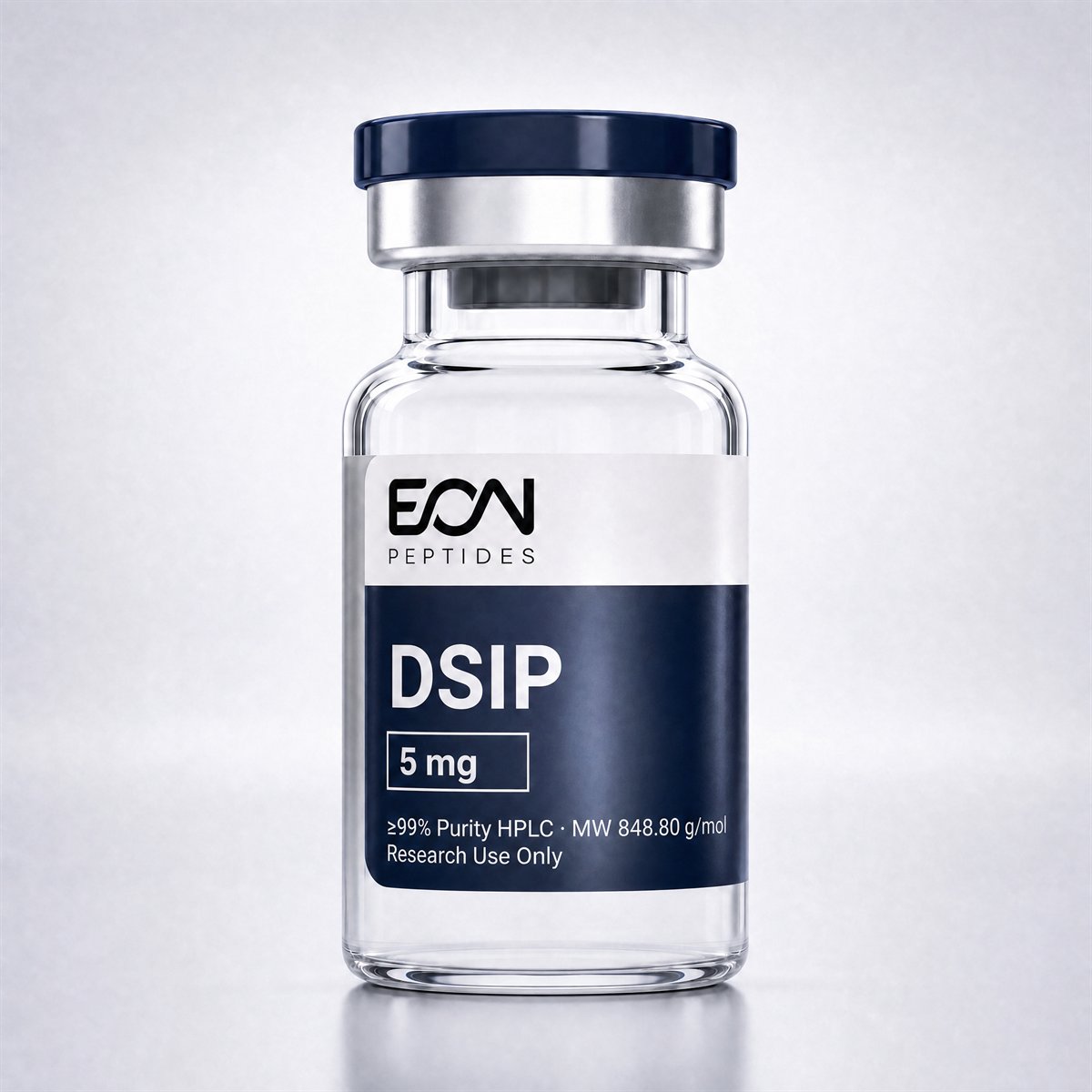
| Molecular weight | 848.8 Da |
| Sequence | Trp-Ala-Gly-Gly-Asp-Ala-Ser-Gly-Glu |
| Sequence length | 9 residues |
| CAS / identifier | 62568-57-4 |
| Physical form | White lyophilized powder |
| Available sizes | 5mg, 10mg |
The sequence
DSIP is published as a 9-residue sequence. It is set below in reading order, ten residues to a row, numbered from the N-terminus. Every position is a standard L-amino acid.
- W Trp
- A Ala
- G Gly
- G Gly
- D Asp
- A Ala
- S Ser
- G Gly
- E Glu
One-letterWAGGDASGE
- Residues
- 9
- Published as
- Three-letter code
- Termini
- Not stated in the specification
How it works
-
Neuromodulator
Neurotransmitter Modulation
DSIP has been reported to influence serotonin (5-HT), glutamate, dopamine and melatonin signaling - pathways tied to sleep onset and circadian timing.
-
Delta Sleep Research
Sleep Architecture
Early studies associate DSIP with greater slow-wave (delta) sleep, shorter sleep onset and higher sleep efficiency, distinct from sedative-hypnotic mechanisms.
-
Neuroprotective
Stress & Neuroprotection
Investigated for adaptation of the stress (HPA) axis and for neuronal oxidative-stress endpoints in neurodegeneration and stroke models.
What the research shows
-
Sleep Research
Sleep Architecture
Studied for effects on slow-wave sleep, sleep efficiency and onset latency in animal and human models.
-
Stress & Endocrine
Stress Adaptation
Investigated for modulation of the HPA axis and stress-response regulation.
-
Neuroscience
Neuroprotection
Explored for antioxidant/neuroprotective effects in models of neurodegeneration and ischemic injury.
Specification
| Also Known As | Delta Sleep-Inducing Peptide, Sleep-Promoting Peptide |
|---|---|
| Type | Nonapeptide neuropeptide |
| CAS Number | 62568-57-4 |
| Molecular Formula | C₃₅H₄₈N₁₀O₁₅ |
| Molecular Weight | 848.8 g/mol |
| Amino Acid Sequence | Trp-Ala-Gly-Gly-Asp-Ala-Ser-Gly-Glu |
| Physical Appearance | White lyophilized powder |
| Purity | ≥99% (HPLC) |
| Content | 10 mg per vial |
| Appearance | White to off-white powder |
| Stability | 24 months from manufacture date when stored properly |
| Storage | Store at -20°C, protected from light |
How it's tested
Every lot of DSIP released to the catalog carries a third-party certificate of analysis. 4 documented lots are on file for this compound, with reported HPLC purity from 99.12% to 99.61% (mean 99.36%), issued by ILS Laboratories, Accurate Test Labs and Freedom Diagnostics. 2 of 4 certificates record identity as confirmed.
- Documented lots
- 4
- Reported purity
- 99.12% to 99.61%
- Mean purity
- 99.36%
- Issuing labs
- ILS Laboratories, Accurate Test Labs, Freedom Diagnostics
- 2026-10-19 Lot DSIP-101926-10ILS Laboratories 99.17% View certificate
- 2026-09-03 Lot DSIP-090226-10Accurate Test Labs 99.61% View certificate
- 2026-08-07 Lot AJ4AUXFreedom Diagnostics 99.12% View certificate
Frequently asked questions
What is DSIP?
DSIP (Delta Sleep-Inducing Peptide) is a naturally occurring nonapeptide first isolated in the 1970s from the cerebral venous blood of rabbits in an induced sleep state, studied as an endogenous modulator of sleep and stress.
Is DSIP naturally occurring?
Yes. DSIP is an endogenous neuropeptide found in the brain, hypothalamus and other tissues, which is part of why it is of interest as a physiological sleep regulator.
What is it researched for?
Primarily sleep regulation, but also stress adaptation, neuroprotection, chronic-pain models and studies of opioid/alcohol withdrawal.
How is it stored?
Supplied as a lyophilized powder; store at -20°C, protected from light and moisture. Research use only.
Selected preclinical literature
8 published studies on DSIP, limited by rule to animal models and cell-based (in vitro) work indexed in PubMed. Human trials, case reports and literature overviews are excluded. Titles appear as published and each links to its PubMed record; the list was resolved against PubMed on 2026-10-12. A listing describes what a study examined, not a property of the material supplied.
-
Rats model
Delta Sleep-Inducing Peptide Recovers Motor Function in SD Rats after Focal Stroke
Molecules (Basel, Switzerland), 2021. PubMed PMID 34500605 · doi:10.3390/molecules26175173
-
Rats model and in vitro
Effect of Delta Sleep-Inducing Peptide on Functional State of Hepatocytes in Rats During Restraint Stress
Bulletin of experimental biology and medicine, 2016. PubMed PMID 26902351 · doi:10.1007/s10517-016-3186-8
-
Rats model
JmjC-domain-containing histone demethylases of the JMJD1B type as putative precursors of endogenous DSIP
Peptides, 2011. PubMed PMID 21262293 · doi:10.1016/j.peptides.2011.01.006
-
Rats and Mice model
Effect of delta sleep-inducing peptide on macromolecule biosynthesis in brain tissue of stressed rodents
Bulletin of experimental biology and medicine, 2006. PubMed PMID 17152359 · doi:10.1007/s10517-006-0187-z
-
Rats model
Delta-sleep-inducing peptide potentiates anticonvulsive activity of valproate against metaphit-provoked audiogenic seizure in rats
Pharmacology, 2006. PubMed PMID 16645330 · doi:10.1159/000093001
-
Rats model
Antiepileptic activity of delta sleep-inducing peptide and its analogue in metaphit-provoked seizures in rats
Seizure, 2005. PubMed PMID 15911358 · doi:10.1016/j.seizure.2005.02.001
-
Rats model
Delta sleep-inducing peptide and its tetrapeptide analogue alleviate severity of metaphit seizures
Pharmacology, biochemistry, and behavior, 2004. PubMed PMID 14751449 · doi:10.1016/j.pbb.2003.10.014
-
Rats model and in vitro
Delta sleep-inducing peptide blocks excitatory effects of glutamate on rat brain neurons
Bulletin of experimental biology and medicine, 2002. PubMed PMID 12459854 · doi:10.1023/a:1020679815690
Cross-references
Other entries in this volume that bear on DSIP, with the reason each one is listed.
For laboratory research use only. Not a drug, supplement, or medical product; not for human or animal use. All findings referenced are from published preclinical/laboratory research.