
Molecular data
| Physical form | Lyophilized powder blend |
|---|---|
| Available sizes | 30mg |
What is in the vial
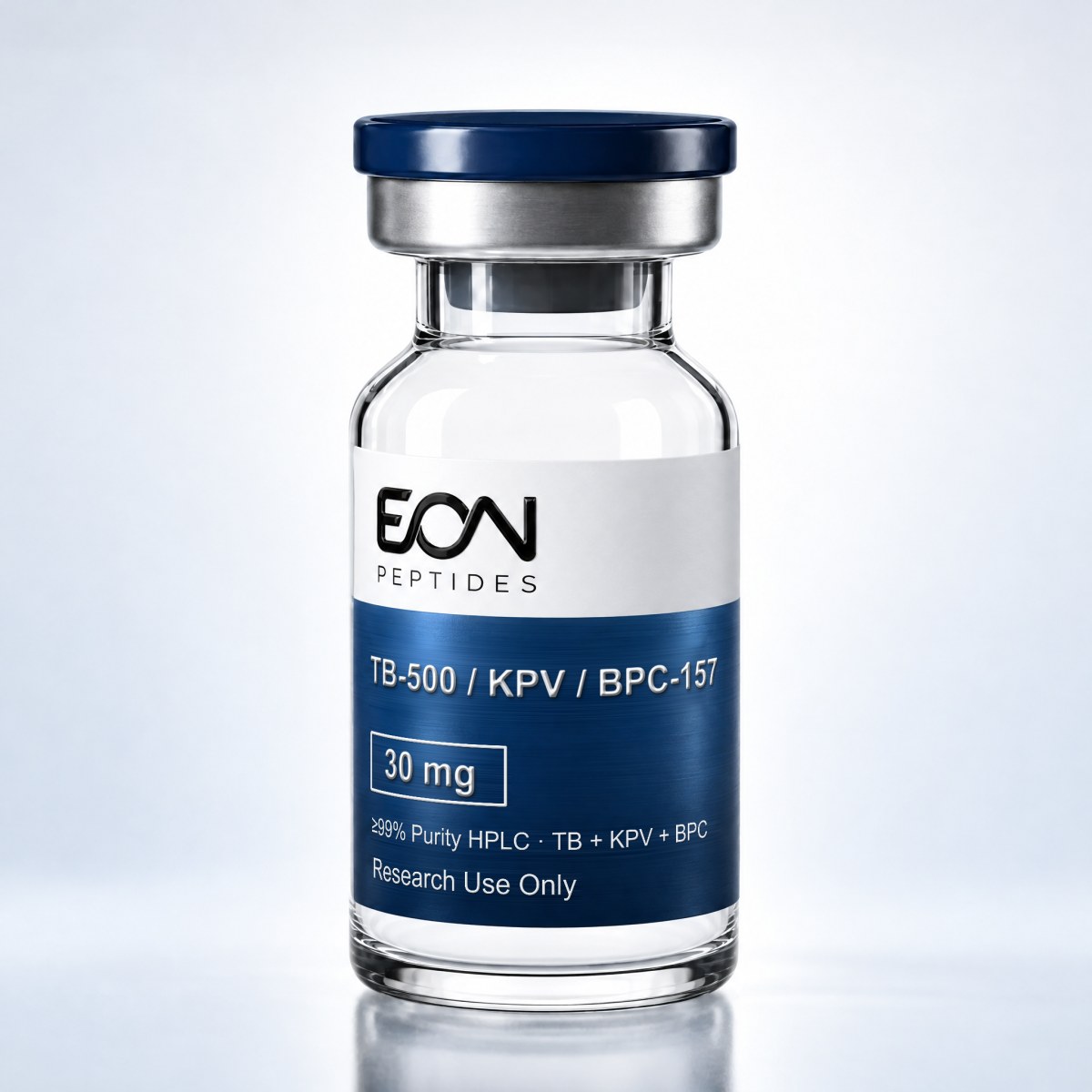
TB-500 / KPV / BPC-157 combines 3 named components in a single 30mg vial. Each one is separately catalogued and has its own monograph. A blend has no single molecular formula or sequence, which is why this entry carries neither.
How it works
-
TB-500
Cell Migration & Actin Regulation
TB-500 sequesters G-actin monomers, with cytoskeletal remodelling and cell migration toward injury sites measured. Integrin-linked kinase (ILK) signalling is also characterised.
- Actin-mediated cell migration
- Integrin-linked kinase activation
- Anti-fibrotic remodeling
-
KPV
Inflammatory Pathway Suppression
KPV is the C-terminal tripeptide of α-MSH. At nanomolar concentrations, lower NF-κB and MAP-kinase pathway activation is measured in vitro, alongside reduced TNF-α, IL-6 and IL-1β secretion. Cellular uptake runs through the PepT1 transporter.
- NF-κB and MAP-kinase inhibition measured
- Lower pro-inflammatory cytokines measured
- PepT1-mediated cellular uptake
-
BPC-157
Angiogenesis & Cytoprotection
Raised VEGF expression and new vessel formation have been measured for BPC-157, alongside perfusion of the surrounding tissue. NO system activity and cytoprotective endpoints are also characterised.
- VEGF-mediated angiogenesis
- Nitric oxide system modulation
- Gastric and tissue cytoprotection
What the research shows
-
Musculoskeletal
Tendon & Ligament
BPC-157 is studied in tendon models while TB-500 is characterised for cell migration toward the injury site; KPV adds an inflammatory-signalling arm to the combined condition.
-
Gastroenterology
Intestinal Inflammation Models
KPV lowered intestinal inflammation scores in DSS- and TNBS-induced colitis models, and BPC-157 is studied for gastric and intestinal cytoprotection.
-
Dermatology
Wound Closure Models
TB-500 is studied in dermal and scarring models, BPC-157 for perfusion at wound sites, and KPV for epithelial re-closure in a corneal model.
-
Anti-Inflammatory
Inflammatory Signalling
Anti-inflammatory endpoints are measured for all three peptides through distinct mechanisms: actin regulation, NF-κB inhibition and the NO system.
Specification
| Components | TB-500 (Thymosin Beta-4) + KPV + BPC-157 |
|---|---|
| Content | 30 mg per vial (10 mg of each component) |
| TB-500 Fragment | 43-amino acid active region of Tβ4 |
| KPV Sequence | Lys-Pro-Val (α-MSH 11-13) |
| BPC-157 Sequence | 15 amino acids (Gly-Glu-Pro-Pro-Pro...) |
| Form | Lyophilized powder blend |
| Purity | ≥99% per component (HPLC verified) |
| Testing | Third-party HPLC, Mass Spec, Endotoxin |
| Storage | -20°C for long-term stability |
| Solubility | Water-soluble |
| COA | Included with every order |
How it's tested
Every lot of TB-500 / KPV / BPC-157 released to the catalog carries a third-party certificate of analysis. 1 documented lot is on file for this compound, with reported HPLC purity from 99.04% to 99.04% (mean 99.04%), issued by Freedom Diagnostics. 1 of 1 certificates record identity as confirmed.
- Documented lots
- 1
- Reported purity
- 99.04% to 99.04%
- Mean purity
- 99.04%
- Issuing labs
- Freedom Diagnostics
- 2026-10-09 Lot 8HEX09Freedom Diagnostics 99.04% View certificate
Frequently asked questions
Why combine TB-500, KPV and BPC-157?
The three peptides act through complementary mechanisms. Cell mobilisation via actin regulation is measured for TB-500, NF-κB inhibition for KPV, and vessel formation and perfusion for BPC-157. The combination covers cellular-migration, inflammatory-signalling and vascular pathways.
How does it differ from BPC-157 / TB-500 and KLOW?
BPC-157 / TB-500 is a two-peptide blend. This blend adds KPV for an inflammatory-signalling arm. KLOW is a four-peptide blend that also includes GHK-Cu.
Has this combination been characterised as a single formulation?
No. The combination has not been characterised as a single formulation. The rationale is based on mechanisms described for each component individually in preclinical models.
Is this blend FDA approved?
No. TB-500, KPV and BPC-157 are not approved by the FDA for any indication. This blend is sold exclusively for in vitro laboratory research purposes and is not intended for human consumption.
How should this blend be stored?
Store lyophilized at -20°C for long-term stability, protected from light and moisture, and avoid repeated freeze-thaw cycles.
Cross-references
Other entries in this volume that bear on TB-500 / KPV / BPC-157, with the reason each one is listed.
For laboratory research use only. Not a drug, supplement, or medical product; not for human or animal use. All findings referenced are from published preclinical/laboratory research.