
Insulin Sensitivity Models
In high-fat diet mouse models, insulin sensitivity, fat accumulation and glucose tolerance were measured following MOTS-c administration, with skeletal muscle AMPK activation as the proposed mediator.

Mitochondrial Metabolism Studies
Free Shipping on orders over $200
Scan the QR code on any vial to verify its batch, COA, and origin in seconds. Secure traceability from our lab to your bench.
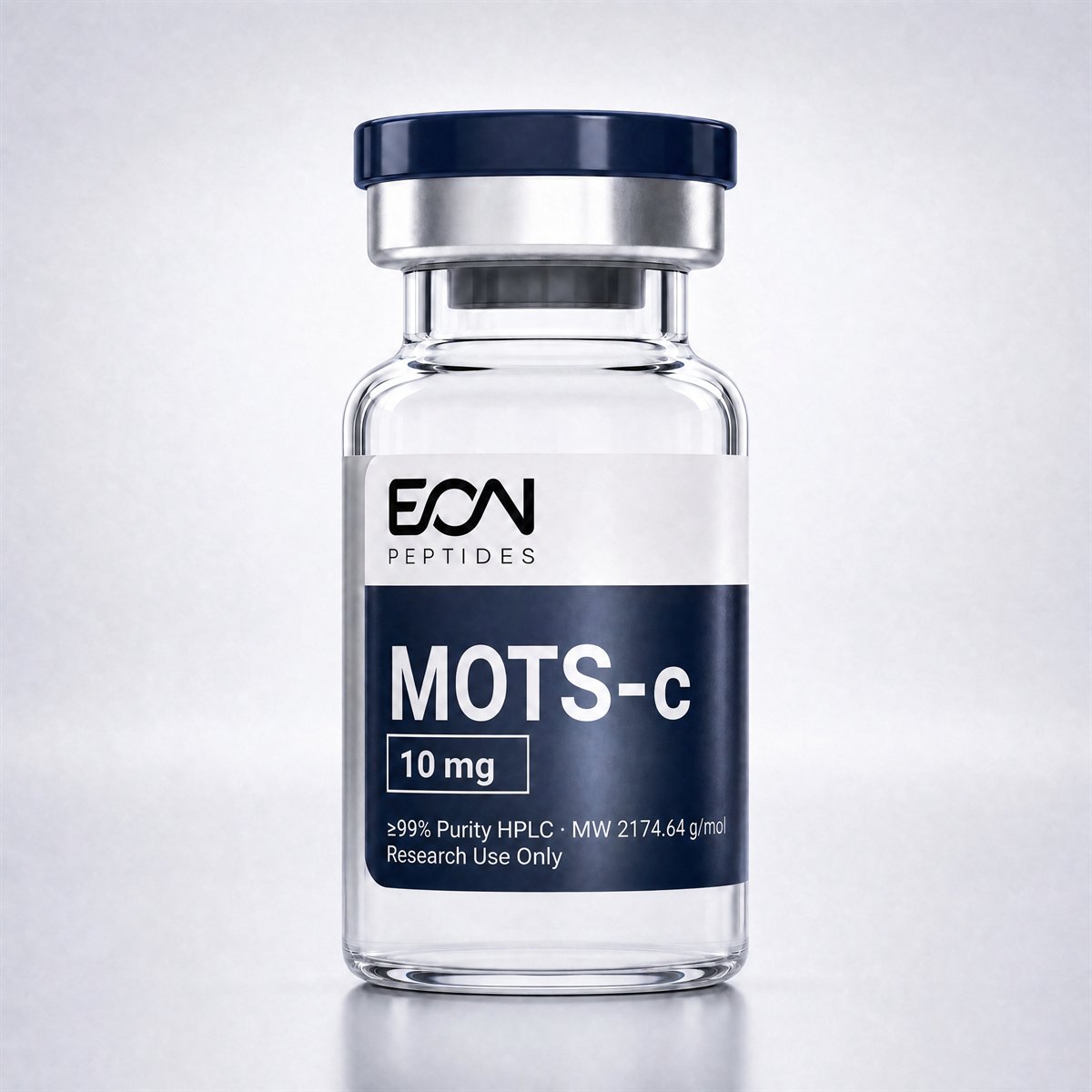
MOTS-c is a short peptide, 16 amino acids long. What makes it unusual is where the instructions for it are stored. They sit inside mitochondrial DNA rather than in the cell nucleus. Studies have measured how it activates AMPK, a pathway that senses cellular energy levels, and how it affects glucose use in muscle models. Only a handful of peptides like it have been found, all within the past twenty years.
Mitochondrial-derived 16-amino acid peptide
The pathways MOTS-c acts on — and what each one does. The animation traces its signal outward from the compound to every target it engages.
MOTS-c activates AMP-activated protein kinase (AMPK) in skeletal muscle, adipose tissue, and liver. AMPK is a master metabolic sensor that responds to cellular energy status. MOTS-c–induced AMPK activation in preclinical models was associated with increased glucose uptake, fatty acid oxidation, and mitochondrial biogenesis signaling.
MOTS-c is encoded within the 12S rRNA gene of the mitochondrial genome — a discovery that established mitochondria as an endocrine organ capable of producing bioactive peptides. Under metabolic stress, MOTS-c translocates from mitochondria to the nucleus where it acts as a transcriptional regulator, modulating antioxidant response element (ARE) gene expression.
MOTS-c levels rise in response to exercise, and in mouse models several exercise-associated metabolic measures were recorded following exogenous MOTS-c — insulin sensitivity, adiposity and endurance — including in sedentary animals. It also acts on the folate cycle and purine synthesis under stress, redirecting metabolic flux.
The main areas MOTS-c is being studied for — and the study-reported figures behind them.
In high-fat diet mouse models, insulin sensitivity, fat accumulation and glucose tolerance were measured following MOTS-c administration, with skeletal muscle AMPK activation as the proposed mediator.
Circulating MOTS-c levels decline with age in both humans and rodents. In aged mouse models, physical performance and metabolic flexibility measures were recorded following exogenous MOTS-c, and are studied in the context of mitochondrial-nuclear communication.
Circulating MOTS-c rises with aerobic exercise in humans. In sedentary mouse models, energy metabolism, mitochondrial biogenesis markers and endurance measures were recorded following exogenous MOTS-c.
Population studies identified MOTS-c variants (particularly R150Q) enriched in elderly Japanese cohorts. Sequence variation correlates with metabolic markers, which is why mitochondrial peptide biology is studied in ageing research.
An interactive 3D model rendered from the compound record — rotate and explore its structure.
C101H152N28O25S2
| Full Name | Mitochondrial Open Reading Frame of the 12S rRNA-c |
| Sequence | MRWQEMGYIFYPRKLR |
| Amino Acids | 16 residues |
| Molecular Weight | 2174.6 Da |
| Gene Origin | Mitochondrial 12S rRNA (mt-RNR1) |
| Primary Target | AMPK activation; folate cycle; nuclear ARE pathways |
| Form | Lyophilized powder (5mg) |
| Purity | ≥99% (HPLC verified) |
| Testing | Third-party HPLC, Mass Spec, Endotoxin |
| Storage | -20°C for long-term stability |
| Solubility | Bacteriostatic water or sterile saline |
| COA | Included with every order |
MOTS-c (Mitochondrial Open Reading Frame of the 12S rRNA-c) is a 16-amino acid peptide encoded within the mitochondrial genome — specifically in the 12S ribosomal RNA gene. Discovered in 2015 by researchers at USC led by Dr. Changhan David Lee, it was one of the first identified mitochondrial-derived peptides (MDPs). Unlike most mitochondrial proteins, MOTS-c is translated from a small open reading frame within non-coding RNA, establishing a new category of regulatory peptides originating from the organelle long considered only a metabolic powerhouse.
Circulating MOTS-c levels in humans and rodents rise in response to aerobic exercise. MOTS-c activates AMPK — the same energy sensor activated by exercise — in skeletal muscle and other metabolic tissues. In preclinical studies, sedentary mice given exogenous MOTS-c showed metabolic changes overlapping those of exercise training: insulin sensitivity, fatty acid oxidation, mitochondrial biogenesis markers and endurance were all measured. This overlap is why MOTS-c is studied in metabolic biology.
MOTS-c levels decline with age in both humans and rodents, inversely correlating with age-related metabolic markers. Population genetic studies identified a MOTS-c variant (R150Q, also called K14Q in some notation systems) enriched in elderly Japanese men. In aged mouse models, physical performance and metabolic flexibility measures were recorded following exogenous MOTS-c, which is why it is studied in ageing biology.
MOTS-c activates AMPK through an indirect mechanism involving the folate cycle. Under metabolic stress, MOTS-c inhibits the enzyme MTHFR (methylenetetrahydrofolate reductase) in the folate-methionine cycle. This disrupts purine nucleotide biosynthesis, causing accumulation of ZMP (5-aminoimidazole-4-carboxamide ribonucleoside monophosphate) — a known AMPK activator. This AICAR-independent pathway for AMPK activation is one of the key mechanistic findings distinguishing MOTS-c from other metabolic peptides.
Human research on MOTS-c primarily consists of observational and correlational studies measuring circulating MOTS-c levels in various populations. These have shown associations between MOTS-c levels and: exercise status, aging, insulin resistance, and cardiovascular disease. Human genetic studies have identified longevity-associated MOTS-c variants. However, no randomized controlled trials of exogenous MOTS-c administration in humans have been completed or published as of 2024.
Store lyophilized MOTS-c at -20°C, protected from light and humidity, and minimize freeze-thaw cycles. MOTS-c is water-soluble, making it suitable for aqueous research systems. For cell culture experiments, filter-sterilize laboratory solutions before use. Always consult published protocols for concentration-specific guidance.
Not for human or veterinary use. For in-vitro laboratory research only. These statements have not been evaluated by the FDA; this product is not intended to diagnose, treat, cure, or prevent any disease. Sold exclusively to qualified researchers and institutions.