Metabolic Receptor Research
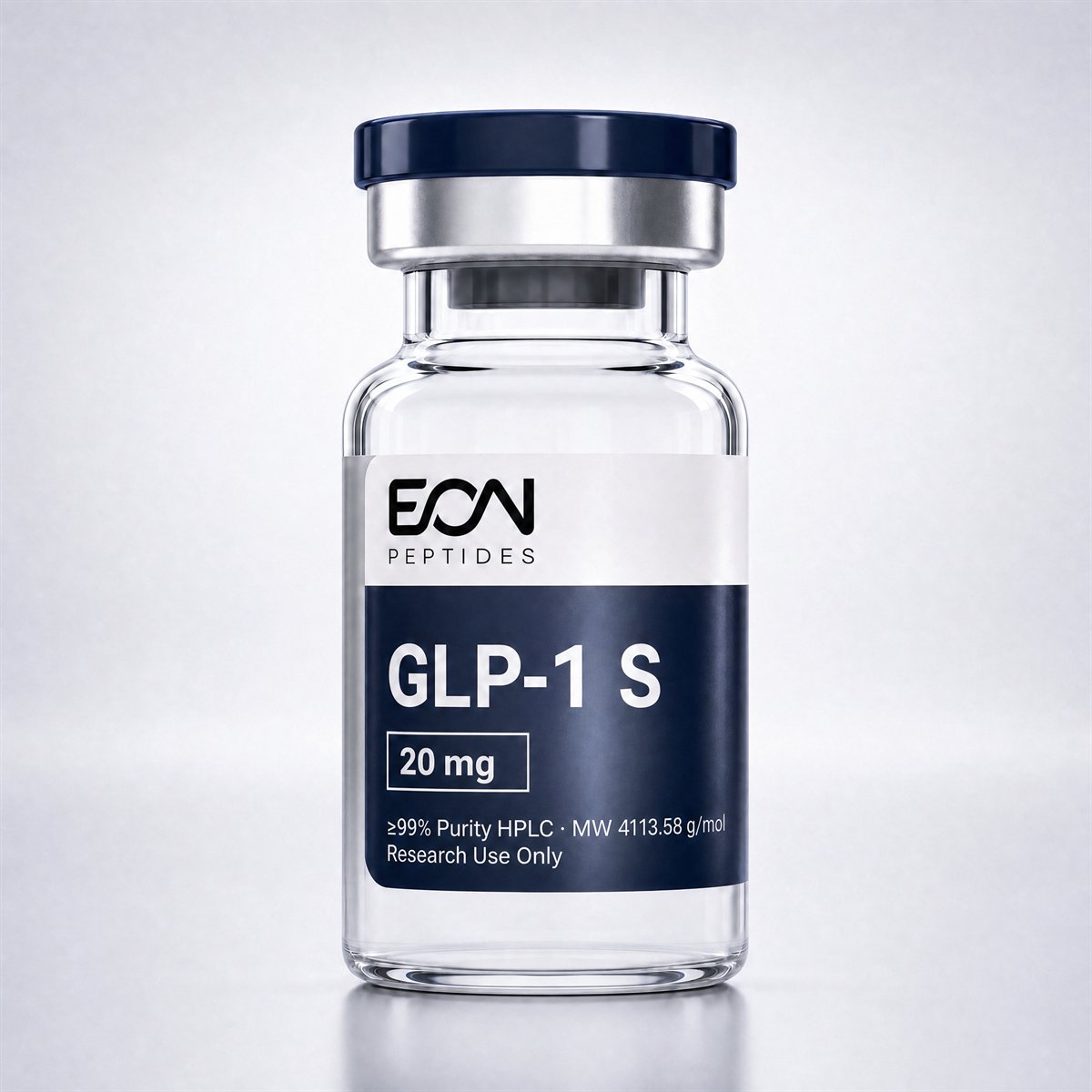
GLP-1 receptor agonism is a principal focus of metabolic research, and GLP-1 S is a selective agonist used as a reference compound in that work.

GLP-1 Receptor Studies
Free Shipping on orders over $200
Scan the QR code on any vial to verify its batch, COA, and origin in seconds. Secure traceability from our lab to your bench.
GLP-1 S is a selective GLP-1 receptor agonist peptide. Its sequence is about 94 percent identical to the endogenous GLP-1 hormone, with one change that resists enzymatic cleavage. Research has measured insulin release, appetite signalling and gastric emptying. A fatty acid chain lets it bind albumin, which extends its half-life.
GLP-1 receptor agonist (incretin mimetic)
The pathways GLP-1 S acts on — and what each one does. The animation traces its signal outward from the compound to every target it engages.
Selectively binds GLP-1 receptors. Published characterisation describes glucose-dependent insulin secretion, glucagon suppression and delayed gastric emptying in study models. Insulin response scales with glucose, a property examined relative to non-incretin secretagogues.
Engages GLP-1 receptors in the hypothalamus and hindbrain, with hunger, satiety and energy intake as the measured endpoints.
A C18 fatty-diacid chain confers reversible albumin binding and resistance to DPP-4 degradation, extending the plasma half-life to roughly 7 days in research models.
The main areas GLP-1 S is being studied for — and the study-reported figures behind them.
GLP-1 receptor agonism is a principal focus of metabolic research, and GLP-1 S is a selective agonist used as a reference compound in that work.
GLP-1 S is studied for glucose-dependent insulin secretion and glycemic endpoints in metabolic research.
Cardiometabolic signalling is a further area of research interest for this receptor class, beyond glucose handling.
GLP-1 receptor signaling in the hypothalamus and hindbrain modulates satiety and food-reward pathways, a focus of ongoing neuroscience research.
An interactive 3D model rendered from the compound record — rotate and explore its structure.
C187H291N45O59
How GLP-1 S clears from circulation, modeled from its documented ~~165 hours (~7 days) half-life. The curve draws as you scroll.
| Compound Class | GLP-1 receptor agonist (incretin mimetic) |
| Research Name | GLP-1 S |
| Target | GLP-1 receptor (GLP-1R) |
| Form | Lyophilized powder |
| Molecular Weight | 4,113.58 g/mol |
| Purity | ≥99% (HPLC verified) |
| Testing | Third-party HPLC, Mass Spec, Endotoxin |
| Half-Life | ~165 hours (~7 days) |
| Storage | -20°C for long-term stability |
| Solubility | Water-soluble |
| COA | Included with every order |
GLP-1 S is a long-acting and selective GLP-1 receptor agonist. It mimics the incretin hormone GLP-1; published characterisation describes glucose-dependent insulin secretion, glucagon suppression, delayed gastric emptying and central appetite-pathway signalling.
GLP-1 S is a single-receptor (GLP-1) agonist. GLP-2 TZ is a dual GLP-1/GIP agonist, and GLP-3 RT is a triple GLP-1/GIP/glucagon agonist. The distinction is receptor coverage.
GLP-1 S has a molecular weight of 4,113.58 g/mol. Every vial is supplied at ≥99% purity, verified by HPLC, with a Certificate of Analysis included.
Store lyophilized vials at -20°C for long-term stability, protected from light and moisture.
No. GLP-1 S is sold strictly as a research compound for laboratory and in-vitro use only. It is not intended for human or animal consumption, diagnosis, or treatment.
Not for human or veterinary use. For in-vitro laboratory research only. These statements have not been evaluated by the FDA; this product is not intended to diagnose, treat, cure, or prevent any disease. Sold exclusively to qualified researchers and institutions.