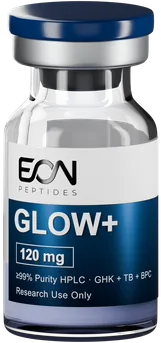
Skin Remodelling Models
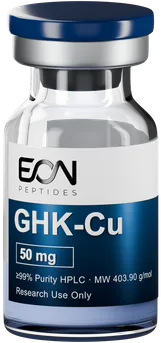
GHK-Cu is characterised for collagen and glycosaminoglycan synthesis in dermal fibroblast culture.


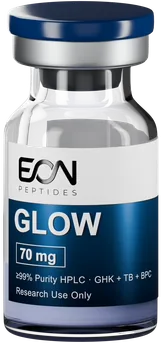
Copper peptide + tripeptide blend · 70 mg lyophilized
Get an email when GHK-Cu / KPV is back
Leave your email and we will send one note the moment it is back in stock.
One email when it restocks, plus occasional Eon updates. Unsubscribe anytime.
Free Shipping on orders over $200
Scan the QR code on any vial to verify its batch, COA, and origin in seconds. Secure traceability from our lab to your bench.
Researchers also added
Research use only.
The Eon standard
Your results are only as good as your compound.
Every lot of GHK-Cu / KPV is tested by an independent ISO/IEC 17025-accredited lab in the USA. 99%+ purity isn't a target here. It's the requirement.
Don't take our word for it: test any vial at an accredited lab of your choice. If HPLC purity comes back under 99%, we refund your order and pay for the test.
This is a blend. GHK-Cu and KPV are combined in a single 70 mg vial at 50 mg and 20 mg respectively. GHK-Cu is a copper-binding tripeptide studied in skin-remodelling and matrix research; KPV is the C-terminal tripeptide of α-MSH studied for NF-κB pathway suppression. The pairing places a matrix-remodelling arm and an inflammatory-signalling arm in one vial. The combination has not been characterised as a single formulation.
Two-peptide blend: GHK-Cu 50 mg + KPV 20 mg
The numbers that define GHK-Cu / KPV and how it is being studied. For laboratory research use only.
GHK-Cu · KPV
50 mg GHK-Cu + 20 mg KPV
Inflammatory signalling regulator
The pathways GHK-Cu / KPV acts on - and what each one does. The animation traces its signal outward from the compound to every target it engages.
GHK-Cu is a copper-binding tripeptide. Collagen and glycosaminoglycan synthesis endpoints are characterised in dermal fibroblast culture, alongside copper-transport activity.
KPV is the C-terminal tripeptide of α-MSH. Lower NF-κB and MAP-kinase pathway activation is measured in vitro at nanomolar concentrations, alongside reduced TNF-α and IL-6 secretion.
The vial pairs a matrix-remodelling arm with an inflammatory-signalling arm. Both are characterised separately; no interaction data exists for the pair.
The main areas GHK-Cu / KPV is being studied for - and the study-reported figures behind them.
GHK-Cu is characterised for collagen and glycosaminoglycan synthesis in dermal fibroblast culture.
KPV is studied for NF-κB pathway suppression and cytokine secretion endpoints.
Both peptides appear in wound-model literature from different mechanistic angles.
One vial holds both peptides under matched handling.
An interactive 3D model rendered from the compound record - rotate and explore its structure.
Molecular model
| Components | GHK-Cu + KPV |
| Content | 70 mg per vial (50 mg GHK-Cu + 20 mg KPV) |
| GHK-Cu Sequence | Gly-His-Lys (copper complex) |
| KPV Sequence | Lys-Pro-Val (α-MSH 11-13) |
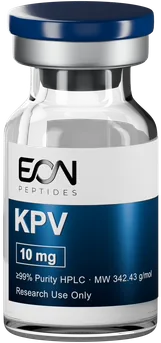
| KPV Molecular Weight | 342.43 g/mol |
| Form | Lyophilized powder blend |
| Purity | ≥99% by HPLC |
| Solubility | Water-soluble |
| Storage | -20°C, protected from light |
| Classification | Research use only |
They cover different arms of skin and inflammation research: GHK-Cu for matrix remodelling, KPV for inflammatory signalling. One vial holds both under matched handling.
The formulation is 50 mg GHK-Cu to 20 mg KPV, following the supplier's specification. It is fixed and cannot be varied within the vial.
No. Each peptide is characterised separately and no interaction data exists for the pair.
Each lot is analysed by reverse-phase HPLC and released at ≥99%, with a Certificate of Analysis.
Store lyophilized at -20°C for long-term stability, protected from light and moisture, and avoid repeated freeze-thaw cycles.
Not for human or veterinary use. For in-vitro laboratory research only. These statements have not been evaluated by the FDA; this product is not intended to diagnose, treat, cure, or prevent any disease. Sold exclusively to qualified researchers and institutions.